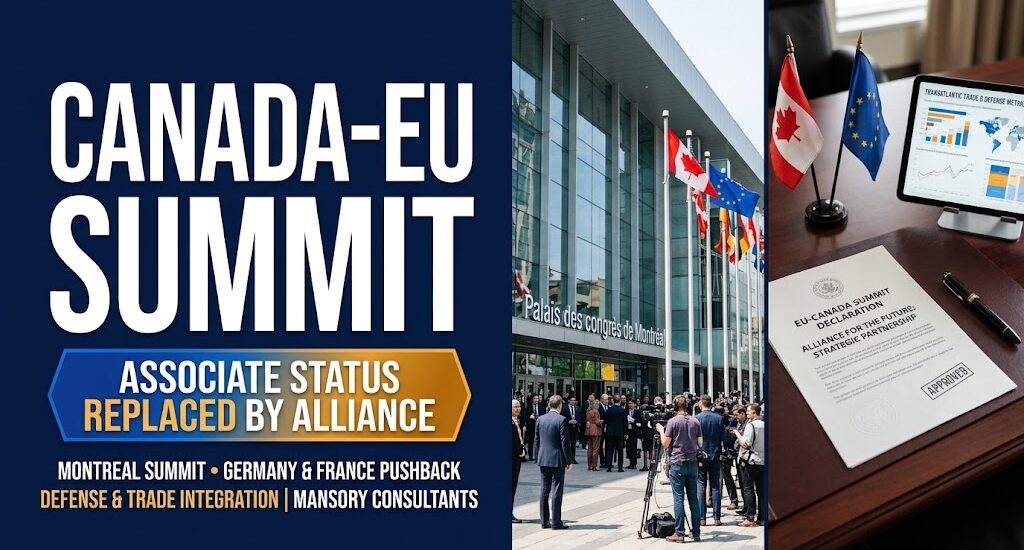
In a major transatlantic diplomatic pivot, European Commission President Ursula von der Leyen’s high-profile push to establish Canada as the European Union’s first-ever “Associate Member” encountered fierce institutional resistance from key member states ahead of the Montreal Summit.
Led primarily by Germany—alongside institutional pushback from France, Italy, and Greece—EU capitals successfully stripped the formal “associate membership” title from the final summit declarations. Rather than creating a novel legal category absent from EU treaties, member states redirected the framework toward a pragmatic “Alliance for the Future” focused on enhanced strategic, trade, and defense integration.
                 [The Transatlantic Status Debate & Evolution]
                                       │
        ┌──────────────────────────────┼──────────────────────────────┐
        ▼                              ▼                              ▼
[The Commission's Proposal]    [Member State Resistance]      [The Compromise Outcome]
• "Associate Member" status    • Led by Germany, France & Italy • Replaced with "Ever Closer Association"
• Proposed by Ursula von der   • No legal basis in EU treaties• Formalized as the new "Alliance
  Leyen ahead of Montreal      • Lack of prior consultation     	  for the Future" at Montreal Summit
1. Why EU Capitals Pushed Back Against the Label
While European capitals broadly supported deepening ties with Ottawa, the sudden introduction of the “associate membership” concept created deep institutional friction:
- Absence of Treaty Frameworks: European legal experts and diplomats from Berlin noted that “associate membership” has no formal definition or mechanism within current European Union treaties, risking legal and procedural ambiguity.
- Lack of Prior Consultation: Commission President von der Leyen floated the concept without securing preliminary consensus from the Council of the European Union, catching national governments off guard.
- Precedent and Parity Concerns: Other closely integrated non-EU partners—such as Norway, Switzerland, Iceland, and traditional association agreement holders—expressed uncertainty over how a unique Canadian tier would affect existing structural arrangements.
2. The Outcome: Launching the “Alliance for the Future” at Montreal
Despite dropping the contentious terminology, the 21st Canada-EU Summit in Montreal successfully delivered a deep, comprehensive framework known as the Alliance for the Future. Rather than getting bogged down in institutional nomenclature, both sides codified tangible cooperation across core pillars:
- Defense & Security Integration: Building on Canada becoming the first non-European country to join the EU’s Security Action for Europe (SAFE) defense initiative, both sides expanded joint defense procurement contracts (such as tactical communications and equipment for Baltic security deployments).
- Critical Minerals & Energy Corridors: Securing long-term liquefied natural gas (LNG) supply chains and critical mineral extraction partnerships to fortify Western industrial sovereignty.
- People-to-People and Research Ties: Expanding Canadian participation in European framework programs, including enhanced academic student mobility and joint technological research initiatives.