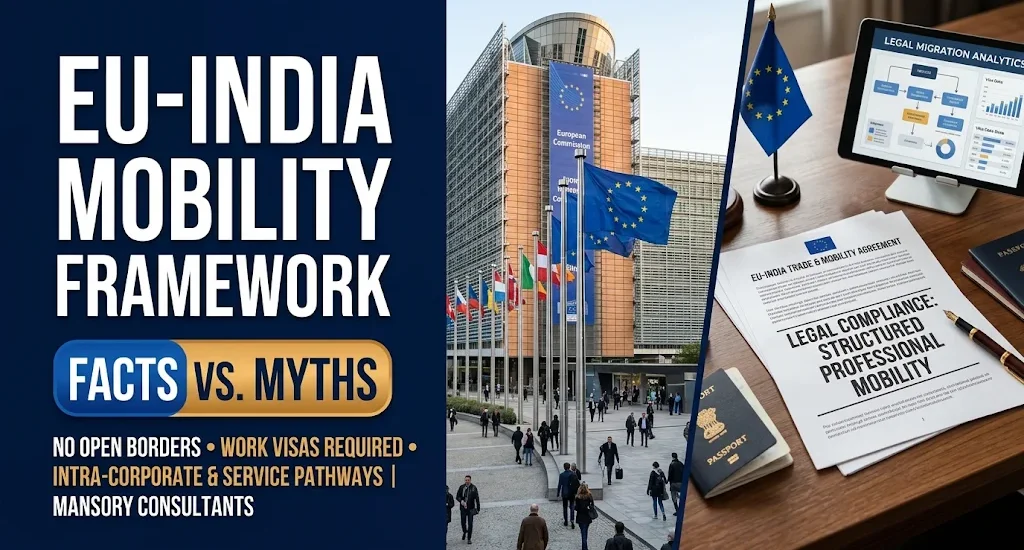
In the wake of viral social media headlines claiming that the European Union signed an open-border immigration pact allowing “millions to enter,” legal experts and consular analysts are emphasizing the need for an important reality check. Following the formal conclusion of the landmark EU–India Free Trade Agreement (FTA) and Comprehensive Framework of Cooperation on Mobility, it is essential to examine what European law and the official bilateral texts actually stipulate.
Rather than opening unvetted borders or issuing automatic residency rights, the agreement establishes a structured, highly regulated framework for temporary professional mobility, corporate transfers, and institutional cooperation across the 27 EU member states.
                 [EU–India Mobility & Trade Framework Architecture]
                                          │
        ┌─────────────────────────────────┴─────────────────────────────────>
        ▼                                                                   ▼
[What the Agreement DOES Cover]                                     [What the Agreement DOES NOT Cover]
• Predictable pathways for Intra-Corporate Transferees (ICTs)       • Does NOT grant automatic work visas
• Streamlined rules for Contractual Service Suppliers               • Does NOT establish open-border migration
• Accelerated 90-day processing timelines for business visas        • Does NOT provide automatic post-study work rights
• Establishment of the EU Move Information Center                   • Does NOT bypass national member-state quotas
1. What the EU–India Mobility Framework Actually Covers
The mobility agreement is designed to facilitate legitimate trade in services and support corporate talent mobility without overriding national sovereignty. The core pillars include:
- Intra-Corporate Transferees (ICTs): Facilitates the temporary transfer of specialized managers, specialists, and trainees within multinational corporations operating in both India and the EU, backed by a target of streamlined administrative processing within 90 days.
- Contractual Service Suppliers & Independent Professionals: Establishes predictable legal criteria for qualified professionals entering the EU temporarily to fulfill verified business service contracts.
- Business Visitors: Simplifies short-term commercial visits for meetings, conferences, or negotiations, occasionally waiving work permit requirements under strictly defined, non-employment activities.
- Institutional Support Initiatives: Outlines plans for the future deployment of an EU Move Information Center in India to provide transparent guidance on legal migration pathways.
2. The Legal Reality Check: What the Framework Does NOT Do
Amid exaggerated online rumors, consular authorities and trade experts have clarified several critical boundaries:
- No Automatic Work Visas: The framework does not grant automatic work visas or unrestricted employment rights to Indian nationals. Every applicant must still satisfy standard national visa laws, background vetting, and document verifications.
- No Post-Study Work Entitlements: The trade agreement does not introduce automatic post-study work rights for Indian students across all EU member states; student immigration remains governed by individual national university and residency laws.
- National Sovereignty Retained: Visa approval authority remains entirely under the control of individual EU member states, meaning national quotas, language proficiency standards, and local labor market tests continue to apply.