
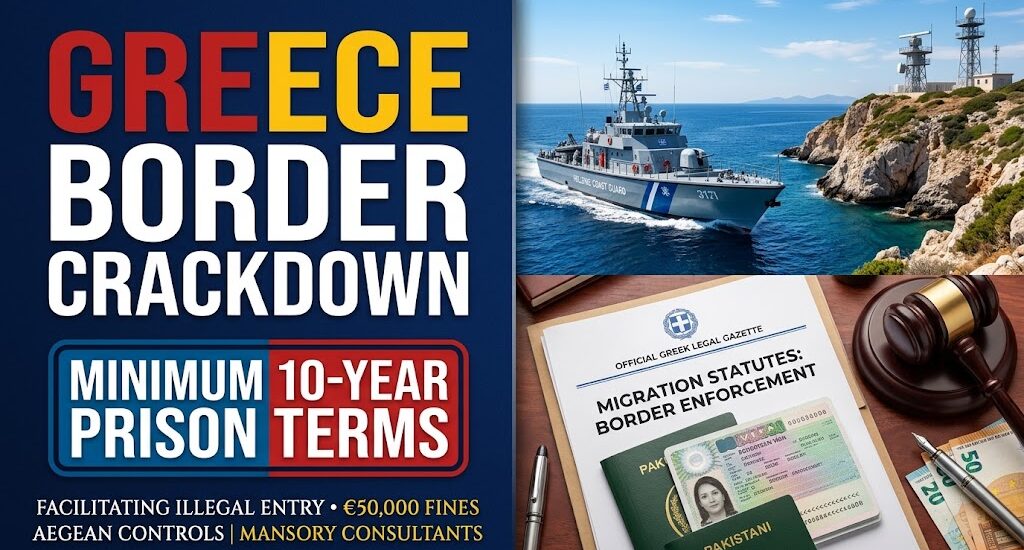
In a significant escalation of European border enforcement and migration policing, the Hellenic Parliament has enacted stringent statutory penalties targeting individuals, humanitarian volunteers, and non-governmental organization (NGO) personnel who facilitate the unauthorized entry or stay of irregular migrants.
Under the updated legislative framework, members of registered or unregistered aid organizations convicted of facilitating unauthorized land or maritime border crossings face a mandatory minimum of 10 years’ imprisonment alongside fines of up to €50,000. The statute eliminates the requirement to prove commercial or financial gain to establish an offense—meaning humanitarian assistance that aids undocumented border navigation can be prosecuted under felony anti-smuggling provisions.
The legislation coincides with intensified maritime patrols by the Hellenic Coast Guard, real-time biometric and thermal surveillance across the Evros river land border, and joint operations with the European Border and Coast Guard Agency (Frontex).
At Mansory Consultants, our legal mobility and international compliance desk highlights these operational changes: the era of informal European entry corridors has been met with severe criminal sanctions. Below is an operational analysis of the Greek statutory crackdown, maritime surveillance networks, and why lawful, documented migration remains the only viable path to Europe.
Greek Border Enforcement & Statutory Penalties at a Glance
| Legal / Enforcement Metric | Statutory Framework Specification |
| Jurisdiction | Hellenic Republic (Greece) / European External Schengen Border |
| Primary Statutory Measure | Enhanced Migration & Border Security Legislation |
| Target Entities | Unlicensed facilitators, smuggling networks & civil society/NGO workers |
| Penalty for Facilitating Entry | Minimum 10 Years Imprisonment + Fines up to €50,000 |
| Commercial Gain Requirement | Removed (Facilitation is penalized regardless of financial profit) |
| Primary Interdiction Corridors | Aegean Sea Islands (Lesvos, Samos, Chios) & Evros Land Border |
| Surveillance Infrastructure | Thermal radar, drone reconnaissance, Hellenic Coast Guard & Frontex |
| Legal Compliance Advisory | Mansory Consultants European Mobility Desk |
1. The Statutory Breakdown: Criminalizing Facilitation
Historically, European maritime border laws differentiated between organized transnational human smuggling syndicates operating for commercial extortion and civil society organizations conducting search-and-rescue or humanitarian assistance. The updated legal provisions in Greece have significantly narrowed that boundary:
[Unauthorized Sea / Land Border Crossing Attempted into Greece]
                               │
                               ▼
[Assistance Provided by Facilitators / Unregistered Personnel]
(e.g., transmitting coordinates, transport, hiding irregular arrivals)
                               │
                               ▼
        ┌──────────────────────┴──────────────────────┐
        ▼                                             ▼
[Commercial Human Smugglers]                 [NGO Workers / Facilitators]
• Aggravated human trafficking charges        • Charged under facilitation provisions
• Multi-decade custodial sentences            • Minimum 10-year prison terms
• Confiscation of vehicles & assets           • Fines up to €50,000 + NGO deregistration
- Removal of the Profit Motive: The new legal standard treats the physical act of aiding, transporting, or coordinating the unauthorized arrival of a third-country national as an offense, removing the requirement to prove financial enrichment.
- Institutional Deregistration: NGOs whose members are charged with facilitation face immediate suspension from the official NGO Registry, asset freezes, and a permanent ban from operating inside state-managed reception and identification centers.
- Direct Impact on Irregular Migrants: Third-country nationals apprehended during irregular entry face immediate detention, rapid biometric indexing into the European Dactyloscopy (EURODAC) database, fast-track deportation orders, and mandatory multi-year entry bans across the Schengen Area.
2. Intensified Maritime & Land Border Architecture
The legal overhaul is accompanied by surveillance upgrades across the Aegean and land entry points:
- Integrated Border Surveillance System (IBSS): High-range thermal optical sensors, fixed radar towers, and long-range acoustic devices deployed along the Evros river border fence with Turkey provide 24/7 automated vehicle and pedestrian detection.
- Aegean Interdiction Corridors: Hellenic Coast Guard patrol vessels, backed by Frontex air assets, conduct round-the-clock interdiction lines across the maritime boundary between the Turkish coastline and Greek eastern Aegean islands (Lesvos, Samos, Chios, and Kos).
- Biometric Pre-Screening: Anyone intercepted is routed into Closed Controlled Access Centres (CCACs), where biometric data is matched against international Interpol and national security databases prior to formal return or expulsion processing.
3. The Human & Legal Cost of “The Dunki Route”
Every year, vulnerable citizens in South Asia fall prey to predatory, unlicensed agents selling illicit passage into Europe via Turkey and Greece—commonly referred to locally as the “Dunki” route:
- Financial Extortion: Families routinely pay upwards of Rs. 2.5 to 4 million (PKR) to clandestine criminal networks, only to face hazardous maritime crossings in unseaworthy rubber dinghies or unventilated shipping containers.
- Severe Detention Conditions: Under Greece’s stricter enforcement, intercepted individuals face prolonged administrative detention in closed facilities without liberty of movement.
- Biometric Blacklisting: Once an individual’s biometric fingerprints and facial scans are recorded as an irregular entrant in the Schengen Information System (SIS II), their ability to ever obtain a legal Schengen, UK, US, or Canadian visa is compromised for years.
4. The Lawful Alternative: The Sovereign European Route
European nations continue to process lawful, regulated visas for qualified individuals through institutional channels. Attempting clandestine border crossings closes off these legitimate options:
[THE RISKY PATH: Smuggling Routes]             [THE SECURE PATH: Mansory Consultants]
• High risk of injury or detention             • Legal student, work & professional visas
• Loss of capital (Rs. 2.5M–4M to mafias)     • Verifiable funds held in your own bank account
• Permanent Schengen SIS biometric bans        • Full Schengen-wide travel mobility & legal residence
• Criminal record under strict laws            • Clear pathway to permanent settlement & citizenship
- Higher Education: Countries such as Sweden, Belgium, the Netherlands, and Germany offer thousands of accredited Bachelor’s, Master’s, and PhD opportunities with post-study work entitlements.
- Short-Term Business & Tourism: Standard Schengen C-visas provide 90-day lawful mobility across 29 European countries when supported by genuine invitations, tax records, and transparent financial capacity.
- National Employment Visas: Regulated employment pathways backed by certified employment contracts, Ministry of Labor approvals, and Bureau of Emigration (BEOE) protections in Pakistan ensure full legal security.
Choose Legal Global Mobility with Mansory Consultants
The tightening of European immigration statutes signals the close of irregular entry routes. Risking life, savings, and personal dignity with unauthorized smugglers or illicit facilitators carries life-altering legal and personal consequences.
At Mansory Consultants, our international higher education, corporate visa, and legal mobility desk delivers:
- Comprehensive eligibility evaluations for verified European university admissions and scholarships across Sweden, the Netherlands, Belgium, and wider Europe.
- Complete educational and civil document legalizations through HEC, IBCC, and the Ministry of Foreign Affairs (MOFA) with digital QR-code verification.
- Full-scope Schengen visa file structuring, bank statement compliance auditing, and consular interview preparation.
- Complete alignment with Pakistan’s Emigration Ordinance, 1979, and international immigration frameworks.
Contact Mansory Consultants today to build a verified, documented, and fully legal pathway to Europe.