
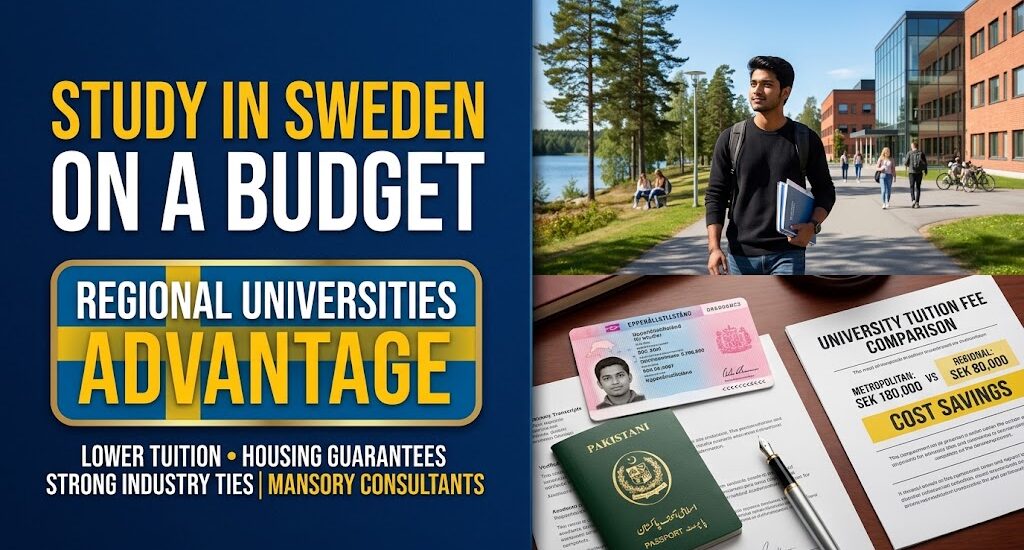
When international students think of studying in Sweden, metropolitan names like KTH Royal Institute of Technology, Stockholm University, or Lund University typically dominate the conversation. However, focusing exclusively on capital cities often comes with steep competition, higher tuition fees, and severe student housing shortages.
For budget-conscious international students seeking an accredited European degree, Sweden’s regional public universities—including Linnaeus University, Mid Sweden University (Mittuniversitetet), University of Gävle, Dalarna University, University of Skövde, and University West (Högskolan Väst)—offer an attractive alternative.
In Sweden, all public higher education institutions operate under the exact same national quality-assurance framework overseen by the Swedish Higher Education Authority (UKÄ). A Master of Science earned at a regional university carries the identical legal status, Bologna credit equivalency (60 or 120 ECTS), and post-study work entitlement as one conferred in Stockholm or Gothenburg.
At Mansory Consultants, our European education and global mobility desk advises students on strategic university selection to maximize admission chances, secure housing early, and reduce financial pressure. Below is a detailed breakdown of the structural, financial, and career advantages of choosing Sweden’s regional universities.
Regional vs. Metropolitan Swedish Universities at a Glance
| Strategic Comparison Parameter | Metropolitan Universities (Stockholm, Lund, Gothenburg) | Regional Universities (Linnaeus, Mid Sweden, Gävle, Skövde) |
| Typical Annual Tuition (STEM / IT) | SEK 140,000 – SEK 210,000+ | SEK 85,000 – SEK 125,000 |
| Typical Annual Tuition (Business/SocSci) | SEK 110,000 – SEK 150,000 | SEK 80,000 – SEK 100,000 |
| Student Housing Availability | Multi-year waitlists (SSSB); critical supply deficit | Guaranteed housing or brief queue times (days to weeks) |
| Monthly Room Rental Cost | SEK 5,500 – SEK 8,500+ | SEK 3,200 – SEK 5,000 |
| Migrationsverket Maintenance Rule | Standard SEK 10,656/month requirement | Standard SEK 10,656/month (actual spend often ~SEK 8,000–9,500) |
| Admission Competition Ratio | Extremely high (Top 2–5% applicant pools) | Balanced; strong focus on meeting specific ECTS criteria |
| Accreditation & Post-Study Work | UKÄ-accredited; 12-month job seeker permit | Identical legal status & 12-month job seeker permit |
| Strategic Advisory Desk | Mansory Consultants European Mobility Desk | Mansory Consultants European Mobility Desk |
1. Substantial Tuition Fee Savings
Because regional institutions are geared toward driving regional economic development and equitable access, their program fee schedules for non-EU students are priced competitively:
[Metropolitan Master's (KTH / Lund): ~SEK 320,000 – 420,000 Total Tuition]
                                   │
                                   ▼ (Save SEK 120,000 to SEK 200,000+)
                                   │
[Regional Master's (Mid Sweden / Gävle / Skövde): ~SEK 160,000 – 240,000 Total Tuition]
- Mid Sweden University (Sundsvall & Östersund): Offers Master’s programs in Computer Engineering, Business Administration, and Tourism Studies starting from approx. SEK 80,000 to SEK 110,000 per year.
- University of Gävle: Specialized programs in Sustainable Energy, Electronics, and Logistics Management range from SEK 75,000 to SEK 95,000 per year.
- Linnaeus University (Växjö & Kalmar): Master’s tracks in Software Technology, Data Science, and Peace & Development Studies average SEK 85,000 to SEK 115,000 per year.
- University of Skövde: Recognized globally for Game Development, Molecular Biotechnology, and Industrial Informatics, with annual fees running SEK 95,000 to SEK 125,000.
2. The Housing Guarantee Advantage
The greatest obstacle facing international students arriving in Stockholm or Gothenburg is not admission—it is finding an apartment. Metropolitan student housing foundations (like SSSB in Stockholm) operate point-based queues where securing a simple corridor room often requires 300 to 600 days of accumulated points.
In contrast, many regional Swedish universities offer an official Accommodation Guarantee for fee-paying non-EU students:
- Växjö (Linnaeus University): The campus in Växjö is designed as a self-contained American-style campus where accommodation, classrooms, libraries, and restaurants sit in close proximity.
- Gävle & Sundsvall: Municipal student housing trusts (such as Gavlegårdarna or Mitthem) reserve blocks of furnished student apartments, ensuring admitted students receive an accommodation contract before applying for their visa.
- Lower Living Outlays: Monthly rental costs in regional towns typically run between SEK 3,200 and SEK 4,800, compared to SEK 6,500–8,500+ in private Stockholm sublets, leaving students with manageable out-of-pocket expenses while satisfying Migrationsverket’s maintenance requirements.
3. Work-Integrated Learning & Specialized Regional Industry
A common misconception is that studying in a smaller city limits career opportunities. In Sweden, industrial production and engineering innovation are distributed across regional hubs:
[University West (Trollhättan)] ➔ Aerospace, Advanced Manufacturing & Robotics Hub
                                    (Pioneer of Work-Integrated Learning - WIL)

[University of Skövde]         ➔ Sweden's Video Game Development Capital & Volvo Engine Plants

[Linnaeus University (Växjö)]   ➔ Global Forestry Tech, Heavy Glassworks & IKEA Headquarters Hub

[University of Gävle]          ➔ Industrial Green Energy, Smart Grid & Steel Engineering Hub
- Work-Integrated Learning (WIL): University West integrates formal academic coursework with paid corporate internships, directly embedding engineering and IT students inside regional automotive and aerospace suppliers.
- Direct Access to Faculty: At regional universities, student-to-professor ratios are significantly lower than in large lecture halls at older metropolitan institutions. Professors maintain close ties with local industrial clusters, making it easier to secure thesis sponsorship and research placements.
4. Higher Merit Scholarship Ratios
Competition for national scholarships (like the Swedish Institute Scholarship for Global Professionals) is intense. However, regional universities allocate dedicated institutional tuition fee waivers (ranging from 25% to 75% coverage) that see lower applicant density:
- Linnaeus University Scholarship: Offers multiple 75% tuition fee reductions each academic cycle for newly admitted degree-seeking students who rank LNU as their first choice.
- University of Gävle Scholarship: Provides 75% tuition fee waivers covering both years of Master’s study across engineering, computer science, and social sciences.
- Mid Sweden University Tuition Fee Waiver: Awards targeted waivers covering 75% of tuition based on academic excellence.
Ranking a regional university as your 1st-priority program on universityadmissions.se significantly increases your probability of securing both admission and an institutional tuition reduction.
5. Post-Study Work Permits & Permanent Settlement
Graduating from a regional university confers identical Swedish immigration entitlements:
- 12-Month Job Seeker Permit: Upon graduation, international students from all UKÄ-accredited institutions are eligible to apply for a 1-year residence permit to seek employment or explore starting a business in Sweden.
- Mobility Across Sweden: Your degree is recognized nationwide. Graduating from Linnaeus, Mid Sweden, or Gävle does not restrict you to working in that region; you are legally eligible to take corporate positions anywhere in Stockholm, Gothenburg, Malmö, or elsewhere in the European Union.
- Pathway to Permanent Residency: Transitioning from a graduate job-seeker permit to an official Swedish Work Permit (Arbetstillstånd) counts toward long-term permanent residency (Permanent Uppehållstillstånd – PUT).
Optimize Your Swedish Admission File with Mansory Consultants
Targeting regional universities is a smart strategic move for students who want high-quality European education without excessive tuition fees, housing waitlists, or high cost of living. Balancing your application rankings between top-ranked flagships and cost-effective regional powerhouses ensures you secure at least one study offer.
At Mansory Consultants, our study abroad and international mobility desk delivers:
- Program mapping balancing course preferences with realistic tuition budgets and scholarship quotas.
- Strategic priority ranking of your 4 Master’s or 8 Bachelor’s choices on
universityadmissions.se. - Professional Statement of Purpose (SOP) drafting and Europass CV restructuring tailored to regional faculty boards.
- Complete educational document attestation management through HEC, IBCC, and the Ministry of Foreign Affairs (MOFA) with digital QR codes.
- Migrationsverket residence permit structuring, bank statement compliance audits, and housing coordination.
Contact Mansory Consultants today to build your balanced, affordable application strategy for Sweden.