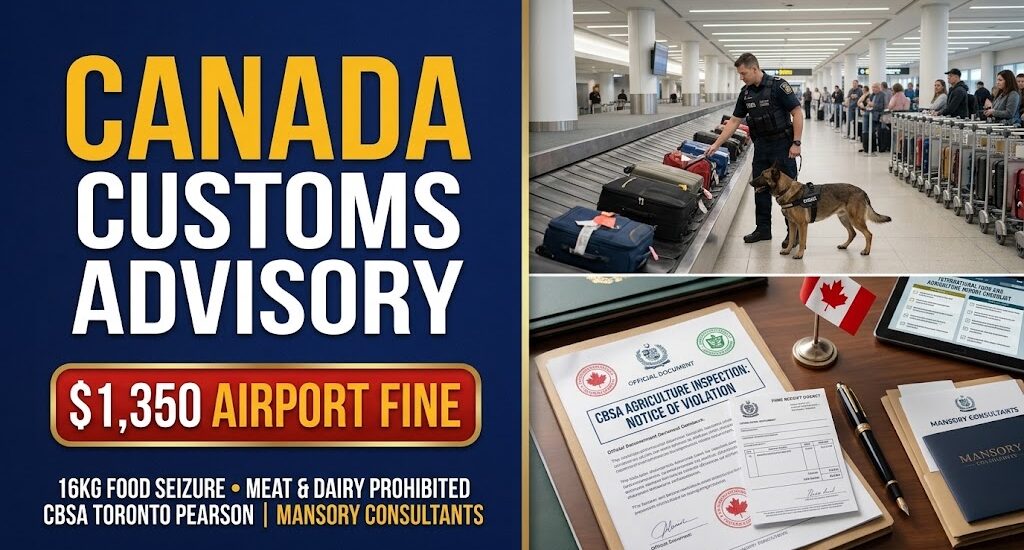
In a strict enforcement of international biosecurity laws and border customs declarations, the Canada Border Services Agency (CBSA) has intercepted a traveler arriving from Pakistan at Toronto Pearson International Airport (YYZ) carrying more than 16 kilograms of undeclared meat, dairy, and agricultural food products.
The undeclared consignment—which included raw chicken, goat trotters (bakray ke paye), homemade desi ghee, and powdered milk—was detected in the passenger’s checked baggage with the assistance of a trained detector dog. Following an intensive secondary agricultural inspection, border officers confiscated the entire batch for immediate destruction and slapped the traveler with an on-the-spot $1,350 CAD Notice of Violation fine under the Agriculture and Agri-Food Administrative Monetary Penalties Act.
The interception highlights a persistent, high-risk compliance blind spot for Pakistani expatriates, international students, and visiting parents flying into North America: assuming that homemade delicacies, vacuum-packed meats, or traditional staples are exempt from border declaration requirements.
                [CBSA Border Biosecurity & Food Interception Flow]
                                        │
        ┌───────────────────────────────┼───────────────────────────────┐
        ▼                               ▼                               ▼
[The Primary Declaration Gate]  [Canine & Secondary Screening]   [Statutory Sanctions Applied]
• Electronic Kiosk / Advance App• Detector Dog sniffs luggage    • Complete seizure & destruction
• Mandatory "Food/Animal" check • In-depth luggage unpack audit  • $1,350 CAD administrative fine
• Strict liability disclosure   • High-risk animal products found• Permanent customs red-flag
• Omitting food = Misleading CBSA• Pathogen & pest cross-check    • Loss of NEXUS / Trusted status
1. Why Canada Enforces Zero-Tolerance on Meat & Dairy Imports
To protect Canada’s agricultural ecosystem, commercial livestock industries, and public health, the CBSA works in direct tandem with the Canadian Food Inspection Agency (CFIA).
Non-commercial, passenger-carried agricultural products from outside North America represent primary vectors for transmissible animal pathogens, such as:
- Foot-and-Mouth Disease (FMD): A devastating viral livestock infection easily carried on untreated raw meats, bone fragments, and unpasteurized dairy.
- Avian Influenza (Bird Flu): Readily transmitted through uninspected poultry, raw chicken cuts, and backyard bird products.
- Bovine Spongiform Encephalopathy (BSE): A persistent neurological cattle disease strictly regulated under international trade protocols.
Because traditional culinary items like goat trotters (paye) and bone-in meats cannot be verified for commercial pathogen sterilization, fresh, raw, dried, or home-cooked meat products from outside the United States are categorically prohibited from entering Canada in passenger luggage.
2. The Golden Rule of Customs: “Declaring” vs. “Concealing”
A common point of confusion among international passengers is the legal distinction between declaring a restricted product and attempting to conceal it:
           [Customs Distinction: Truthful Disclosure vs. Concealment]
                                        │
        ┌───────────────────────────────┴───────────────────────────────┐
        ▼                                                               ▼
[Path A: Honest Declaration]                                    [Path B: Failure to Declare]
• Check "YES" to food/animal items on the kiosk                 • Check "NO" to avoid luggage inspection
• Declare all packaged foods to the officer                     • Hope detector dogs or scanners miss the items
• Officer inspects products at secondary counter                • Scent-detection dog flags luggage immediately
• Inadmissible food surrendered and discarded safely            • Mandatory seizure of all items
• ZERO monetary fines issued                                    • Fines up to $1,300–$1,350 CAD imposed
• Clean border travel record preserved                          • Permanent inspection flag attached to passport
As the CBSA repeatedly clarifies, declaring a food item is free and legal. If a declared item turns out to be inadmissible under CFIA guidelines, the border officer simply confiscates the product for biological disposal. The traveler pays no penalty and proceeds through the airport without a recorded violation.
However, if a traveler checks “NO” on their customs declaration card or electronic kiosk screen and is subsequently caught with food, the act transitions legally into failing to declare and providing false statements under the Customs Act. This triggers automated administrative monetary penalties (AMPs) ranging from $500 up to $1,350 CAD per infraction, with repeat or egregious offenses escalating to criminal prosecution.
                 [Step-by-Step Baggage Clearance at Canadian Ports]
                                         │
                                         ▼
            [Step 1: Complete Declaration via Advance CBSA Tool or Kiosk]
          (Explicitly Select 'YES' for Food, Plants, Animals, or By-Products)
                                         │
                                         ▼
            [Step 2: Collect All Checked Bags from Baggage Carousel]
           (Detector Dogs Patrol Bag Belts and Passenger Queues Actively)
                                         │
                                         ▼
            [Step 3: Hand Receipt to CBSA Exit Point Officer]
          (Officer Either Clears You or Directs Bag to Secondary Agriculture)
                                         │
        ┌────────────────────────────────┴────────────────────────────────┐
        ▼                                                                 ▼
[If Directed to Secondary (Declared)]           [If Caught Concealing (Undeclared)]
• Luggage opened and inspected                  • Luggage opened under enforcement
• Non-compliant meats surrendered peacefully    • Goods confiscated for incineration
• Compliant commercially sealed sweets cleared  • $1,350 statutory violation fine issued
• Walk out without fines or passport blackmarks • Mandatory secondary search on every future entry
3. Long-Term Travel Consequences: The Customs “Red Flag”
Beyond the immediate financial penalty of $1,350 CAD, getting caught with undeclared food creates long-term immigration and border screening repercussions:
- Internal Enforcement Indexing: The passenger’s personal identification, passport number, and biometric file are logged in the CBSA’s internal enforcement database.
- Mandatory Secondary Inspections: For years following an infraction, the traveler’s name triggers an automated referral at airport kiosks, subjecting them and their accompanying family members to thorough, mandatory baggage searches every time they enter Canada.
- Loss of Trusted Traveler Privileges: Any current or prospective eligibility for fast-track border schemes (such as NEXUS or CANPASS) is revoked permanently.
- Impact on Temporary Status & PR: While an administrative agricultural penalty does not automatically cancel a student visa or permanent residence card, unresolved fines, deliberate concealment, or secondary non-compliance records can be used by immigration officers to scrutinize an applicant’s credibility and general admissibility under Section 40 of the Immigration and Refugee Protection Act (IRPA).
4. Mandatory Pre-Flight Checklist for Travelers from Pakistan
To ensure a frictionless arrival in Canada, Mansory Consultants advises all Pakistani travelers, overseas families, and departing students to follow strict baggage protocols:
- Leave Fresh and Homemade Meats Behind: Never pack raw, parboiled, cooked, or frozen meats (including beef, mutton, chicken, game, or organ meats).
- Scrutinize Dairy and Fats: Traditional unpasteurized desi ghee, home-churned butter, and unpackaged milk solids are strictly prohibited unless commercially sealed, shelf-stable, and accompanied by manufacturer origin labels conforming to CFIA standards.
- Declare Every Food Item: If you are carrying commercially packed tea, dry fruit, spices, or vacuum-sealed traditional sweets (mithai), always declare them by checking “YES” on your declaration kiosk or ArriveCAN app. Present the items transparently to the CBSA officer upon inquiry.
- Educate Visiting Parents: Elder family members frequently pack homemade snacks and frozen delicacies out of familial affection, unaware of international biosecurity laws. Family sponsors must thoroughly audit all checked luggage before airport departure in Pakistan.
At Mansory Consultants, our international travel compliance desk regularly guides students, migrating families, and corporate executives on global border regulations, customs protocols, and visa admissibility standards to ensure safe, lawful international journeys