
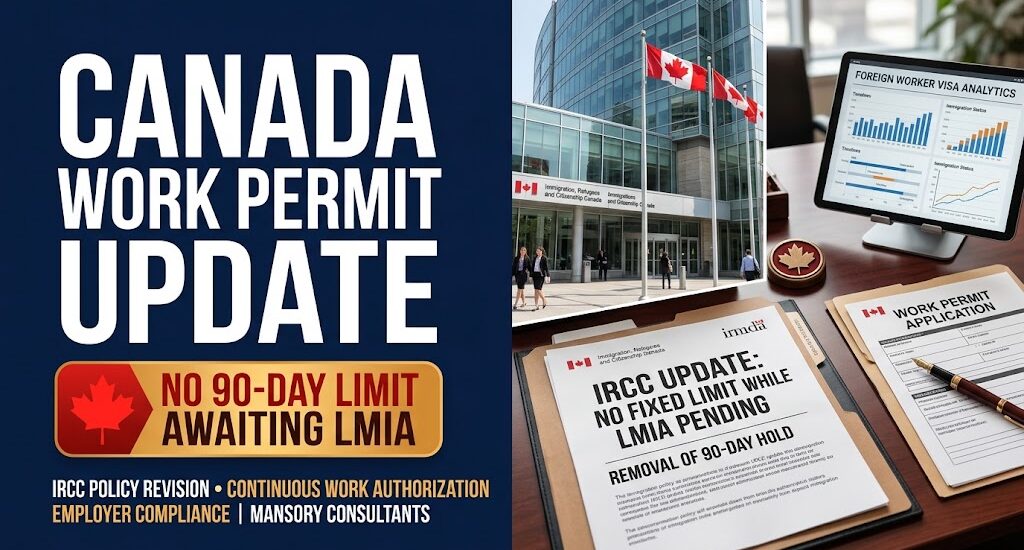
In a major operational policy update for temporary foreign workers and Canadian employers navigating labor shortages, Immigration, Refugees and Citizenship Canada (IRCC) has updated its Program Delivery Instructions (PDIs), officially removing the fixed 90-day time cap on maintaining work authorization while waiting for a Labour Market Impact Assessment (LMIA) decision from Employment and Social Development Canada (ESDC).
Previously, under strict concurrent processing guidelines, temporary foreign workers whose work permits were expiring while an LMIA application was pending could only maintain implied status and legal work authorization for a maximum temporary cap of 90 days. If ESDC processing delays exceeded that window without a finalized LMIA, workers faced severe operational disruptions, administrative freezes, or mandatory cessation of employment.
The updated IRCC directive addresses chronic processing backlogs, offering much-needed stability for employers and foreign talent across Canada.
                 [IRCC Work Permit Extension & LMIA Processing Architecture]
                                             │
        ┌────────────────────────────────────┼────────────────────────────────────┐
        ▼                                    ▼                                    ▼
[Previous Regulatory Limitation]       [The New IRCC Operational Rule]      [Immediate Benefits for Workers]
• 90-day strict cap on extensions    • Removal of fixed time limit        • Eliminates work stoppage anxiety
• Forced work stoppages on delays    • Maintains status until LMIA final  • Protects retention for employers
• Created administrative backlogs    • Aligns with ESDC processing reality• Seamless continuity of payroll
1. How Concurrent Processing Works Under the New Directive
The revised framework applies specifically to foreign nationals who submitted an employer-specific work permit extension application concurrently with an LMIA application before their current work permit expired.
- Continuous Work Authorization: Under maintained status provisions, eligible workers can continue working legally in Canada for the same employer under the conditions of their original permit beyond the former 90-day ceiling.
- Binding to ESDC Adjudication: The temporary work authorization remains valid until IRCC makes a final determination on the work permit application, which is contingent upon ESDC issuing a final decision (positive or negative) on the underlying LMIA.
- Eliminating Disruptive Interuptions: Employers no longer need to bench workers or transition them to temporary leave status due to arbitrary administrative caps while awaiting federal labor market verifications.
                 [The LMIA & Work Permit Extension Pipeline]
                                             │
                                             ▼
             [Worker Submits Concurrent Extension & Employer Files LMIA]
                                             │
                                             ▼
             [Current Work Permit Expires — Maintained Status Commences]
                                             │
        ┌────────────────────────────────────┴────────────────────────────────────┐
        ▼                                                                         ▼
[ESDC Completes LMIA Adjudication]                                        [IRCC Finalizes Work Permit Extension]
• Positive or negative LMIA determination issued                          • Positive LMIA enables permit issuance
• Details transmitted securely to IRCC database                           • Negative LMIA triggers wind-down rules
• Zero arbitrary 90-day work stoppage threat                              • Full legal status renewed seamlessly
2. Strategic Advisory for Employers and Foreign Workers
While the removal of the 90-day cap provides valuable operational breathing room, immigration legal advisors emphasize strict adherence to compliance standards:
- Maintain Valid Submission Proof: Both employers and workers must retain official IRCC submission confirmation notices and ESDC application tracking numbers to present during provincial labor audits or health card renewals.
- Monitor Employer Compliance: Employers remain fully accountable for wage, working condition, and job description integrity throughout the extended processing window.