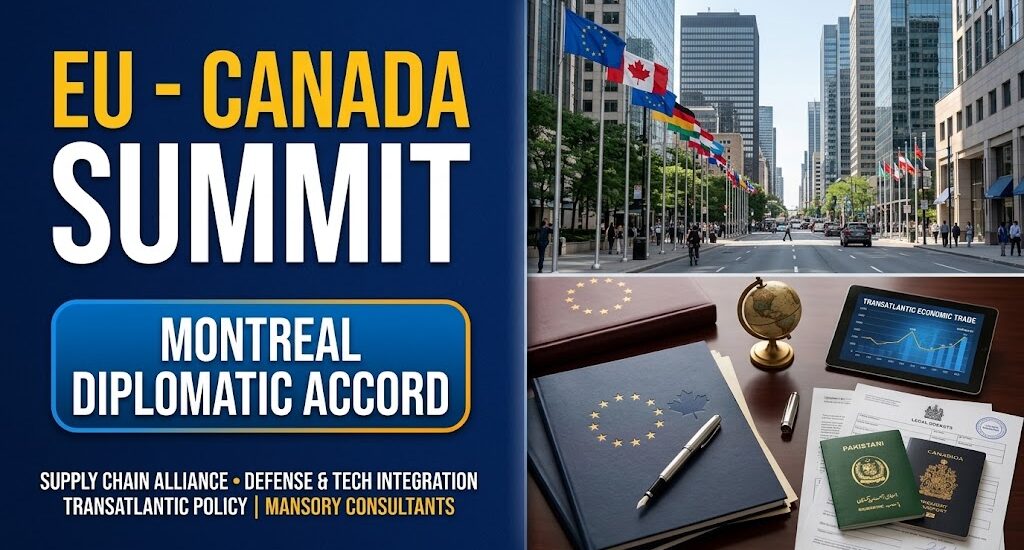
In a notable diplomatic recalibration across the North Atlantic, the European Union has officially removed the formal designation of “Associate Membership” from its joint declaration with Canada ahead of the high-stakes Canada–EU Leaders’ Summit in Montreal.
The ambitious diplomatic initiative—championed by European Commission President Ursula von der Leyen alongside Canadian Prime Minister Mark Carney—sought to create an unprecedented institutional status for Canada as the EU’s first-ever “Associate Member.” However, the proposal met coordinated institutional pushback from key European capitals, led by Germany, France, Italy, and Greece, forcing European negotiators to strike the specific terminology from the final summit text.
The revised bilateral framework instead pivots toward an “Alliance for the Future” and an “ever closer association without accession.” While avoiding treaty-level constitutional titles, the pact focuses on practical integration: securing transatlantic critical raw material supply chains, synchronizing artificial intelligence supercomputing networks, coordinating Arctic defense strategies, and advancing professional skills mutual recognition.
                 [The Canada-EU Transatlantic Diplomatic Matrix]
                                        │
        ┌───────────────────────────────┼───────────────────────────────┐
        ▼                               ▼                               ▼
[Von der Leyen's Ambition]      [The Member-State Red Line]      [Practical Summit Outcome]
• Proposes "Associate Member"   • Germany, France, Italy, Greece • Rebranded "Alliance for Future"
• Deep political integration    • No legal basis in EU Treaties  • Single strategic supply chains
• Access to EU decision loops   • Fears of third-country claims  • Access to 12 EU supercomputers
• Unprecedented non-EU status   • Unratified CETA sensitivities  • Deeper Arctic & Erasmus ties
1. Why European Capitals Drew a Red Line
The proposal to brand Canada as an associate member was initially floated to institutionalize Ottawa’s strategic alignment with Brussels in an increasingly fragmented global economy. However, the concept encountered systemic resistance among key EU member states:
- Absence of a Legal Treaty Framework: Under the Treaty on European Union (TEU), there is no statutory, defined category of “Associate Membership.” Member states, led by Berlin—which characterized the phrase as a “red line”—cautioned that establishing undefined quasi-membership rights risked creating ambiguous legal obligations and bypassing established European Council oversight.
- Precedent and Third-Country Accession Friction: Diplomats in Paris and Rome raised concerns that granting an official associate title to an advanced G7 partner across the Atlantic would trigger diplomatic complications elsewhere. Candidate countries enduring rigorous, multi-year enlargement processes—as well as third countries such as the United Kingdom, Switzerland, and Norway—could argue for similar bespoke institutional privileges.
- The Unresolved CETA Bottleneck: Despite the provisional implementation of the Comprehensive Economic and Trade Agreement (CETA) for nearly a decade, full ratification remains stalled in several national and regional parliaments, including France, Italy, and Greece. Member-state governments argued that creating an elevated political label was premature while parliamentary holdouts on existing bilateral trade pacts persisted.
          [Strategic Divergence: Institutional Label vs. Functional Reality]
                                          │
        ┌─────────────────────────────────┴─────────────────────────────────┐
        ▼                                                                   ▼
[Proposed "Associate Member" Label]                                 [Adopted Functional Partnership]
• Symbolic quasi-political status                                   • Strategic critical minerals integration (+62% imports)
• Complex constitutional renegotiation                              • Canadian access to European AI supercomputing clusters
• Stalled by national parliamentary opposition                      • Defense procurement alignment & Arctic security pacts
• Dropped to preserve European Council unity                        • Deepened participation in Horizon Europe & Erasmus
2. Functional Substance: What the Montreal Partnership Actually Delivers
Addressing the nomenclature controversy, Canadian Prime Minister Mark Carney emphasized that functional sovereignty and material benefits take precedence over diplomatic titles: “The good news is it doesn’t matter about specific names or nomenclature. What matters is the difference it will make to the lives of Canadians.”
Despite dropping the label, the summit advances several concrete, high-level economic initiatives:
- Strategic Supply Chain Corridor: The EU and Canada are formalizing a unified space for strategic supply chains, backed by joint public-private investment frameworks and infrastructure financing. With EU imports of Canadian critical raw materials (such as lithium, cobalt, and nickel) surging 62% in value, the pact aims to insulate both markets from geopolitical export restrictions.
- Advanced Supercomputing & AI Access: Canadian research institutions, universities, and artificial intelligence startups will gain direct operational access to the European Union’s network of 12 advanced supercomputers, creating a joint tech development axis.
- Arctic & Defense Alignment: Canada becomes an active non-European collaborator under the EU’s joint defense procurement frameworks, with dedicated working groups addressing Arctic defense infrastructure, maritime surveillance, and counter-hybrid defense strategies.
- Professional Mobility and Academic Integration: The EU is expanding Canada’s participation in Horizon Europe and the Erasmus+ academic mobility network, while bilateral committees work to fast-track the mutual recognition of professional qualifications across engineering, tech, and specialized services.
3. Strategic Mobility Advisory: Navigating the Transatlantic Corridor
For multinational corporations, investors, and high-skilled professionals operating across Canada, the UK, and the European Union, the Montreal Summit confirms that transatlantic economic integration is expanding through specialized sector treaties rather than single political labels:
- CETA Labor Mobility Pathways: High-skilled executives, intra-company transferees, and contractual service suppliers should continue utilizing existing CETA provisions for streamlined work authorizations across ratified EU member states.
- Research and Academic Mobility: Expanded participation in Horizon Europe and Erasmus creates funded opportunities for Canadian postgraduates and senior researchers to secure fully funded doctoral and postdoctoral fellowships at European research hubs.
- Cross-Border Regulatory Compliance: As the EU harmonizes supply chain provenance, corporate due diligence, and carbon border adjustment mechanisms (CBAM), Canadian exporters must ensure technical compliance with European regulatory standards.
At Mansory Consultants, our international policy and corporate mobility intelligence desk monitors high-level diplomatic agreements to help global enterprises, executives, and academic researchers navigate evolving cross-border immigration, credential recognition, and transatlantic opportunities