
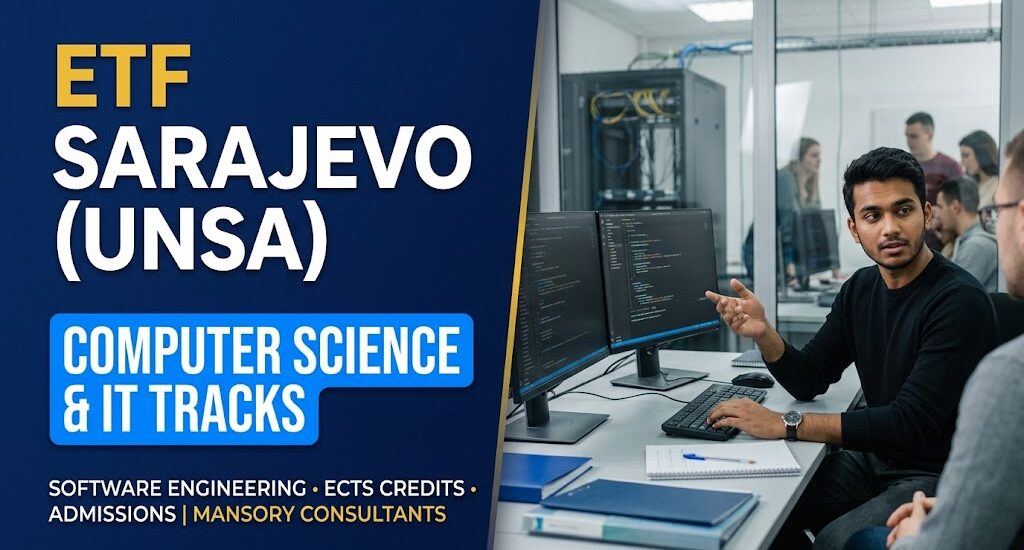
Explore Computer Science, Software Engineering, and IT tracks at the Faculty of Electrical Engineering (ETF) Sarajevo, University of Sarajevo. Learn about Bologna ECTS credits, curricula, admissions, and careers with Mansory Consultants.
The Faculty of Electrical Engineering (Elektrotehnički fakultet u Sarajevu – ETF) at the public University of Sarajevo (UNSA) is the leading technical and computing faculty in Bosnia and Herzegovina. Since its founding in 1961, ETF has served as the academic engine driving the region’s software development, digital infrastructure, and industrial electronics sectors.
For international students aiming to build careers in software engineering, artificial intelligence, telecommunications, or embedded systems, ETF provides rigorous European Bologna-standard degrees at affordable public university tuition rates.
At Mansory Consultants, our international engineering admissions desk assists students through every stage—from transcript review and Cantonal nostrification to student visa processing. Below is a comprehensive guide to ETF Sarajevo’s computing departments, curricula, admission requirements, and career opportunities.
ETF Academic Profile at a Glance
| Feature | Institutional Specification |
| Faculty Name | Faculty of Electrical Engineering (Elektrotehnički fakultet – ETF) |
| Parent Institution | University of Sarajevo (UNSA) |
| Flagship Computing Department | Computing and Informatics (Računarstvo i informatika – RI) |
| Undergraduate Workload | 3-Year Track (180 ECTS) or 4-Year Professional Equivalent |
| Postgraduate Workload | 2-Year Master of Science (120 ECTS) |
| Degree Standard | Fully compliant with the Bologna Process (EHEA) |
| Advisory & Application Support | Mansory Consultants |
1. Core Computing & Technology Departments
ETF organizes its academic programs into specialized engineering departments designed to align with both global tech benchmarks and local industry needs:
A. Computing and Informatics (Računarstvo i informatika – RI)
- Focus: Theoretical computer science, advanced algorithms, object-oriented software engineering, database design, and cloud architectures.
- Key Languages & Tooling: C++, Java, Python, SQL, modern web frameworks, and enterprise software patterns.
- Target Roles: Full-Stack Software Engineers, Systems Architects, and Backend Developers.
B. Telecommunications (Telekomunikacije – TK)
- Focus: Network engineering, digital communications, 5G wireless architectures, network security, and internet protocols.
- Practical Training: Hands-on lab work covering routing protocols, network virtualization, and signal processing.
- Target Roles: Network Engineers, Telecom Infrastructure Specialists, and Cybersecurity Analysts.
C. Automatic Control and Electronics (Automatika i elektronika – AE)
- Focus: Robotics, cyber-physical systems, embedded firmware, industrial automation, and microelectronics.
- Target Roles: Robotics Engineers, Embedded Systems Programmers, and IoT Developers.
D. Electric Power Engineering (Elektroenergetika – EE)
- Focus: High-voltage systems, renewable energy integration, power grids, and smart grid automation.
2. Degree Framework: ECTS Credits & Curriculum
ETF adheres to European Bologna standards, ensuring that credits transfer across the European Higher Education Area (EHEA):
[Undergraduate: 180 ECTS / 3 Years]
                 │
                 ▼
[Postgraduate / Master: 120 ECTS / 2 Years]
                 │
                 ▼
[Combined Qualification: 300 ECTS Target]
- First Study Cycle (Bachelor’s): Spans 6 semesters (180 ECTS credits). The first two semesters build core engineering fundamentals: Advanced Calculus, Physics for Engineers, Linear Algebra, and Structured Programming in C/C++. Subsequent semesters transition to software development, operating systems, and computer architecture.
- Second Study Cycle (Master’s): Spans 4 semesters (120 ECTS credits). Students tackle advanced topics such as machine learning, distributed systems, cryptographic security, and complete an applied Master’s Thesis.
- Diploma Supplement: Graduates receive an official Diploma Supplement in English, ensuring smooth equivalence assessments with organizations like the HEC in Pakistan and licensing bodies across the EU.
3. Tuition Fees and Living Expenses
As a state-subsidized public faculty of the University of Sarajevo, ETF offers lower costs compared to Western European engineering colleges charging €10,000 to €20,000 annually.
- Annual Tuition Fees: Tuition for self-financing international students typically ranges between €1,500 and €3,000 per academic year (approx. BAM 3,000 to BAM 6,000), depending on the cycle and faculty regulations.
- Student Maintenance: Rent, food, utilities, and public transport in Sarajevo average €300 to €500 per month, making it feasible to complete a technical degree without taking on significant debt.
4. Academic Eligibility & Entry Criteria
Admissions at ETF are competitive and reward solid mathematical and analytical preparation.
Undergraduate Eligibility
- High School Completion: 12 years of formal education (FSc Pre-Engineering, ICS with Mathematics and Physics, A-Levels with Mathematics and Physics, or equivalent technical diploma).
- Academic Merit: Strong performance in Mathematics and Physics across past transcripts. Competitive candidates typically hold at least 60% to 70% aggregate marks.
- Entrance Mathematics Examination: Applicants must pass the faculty’s entrance examination in Mathematics or an evaluated equivalent academic assessment.
Postgraduate (Master’s) Eligibility
- Undergraduate Degree: A recognized Bachelor’s degree in Computer Science, Electrical Engineering, Software Engineering, or an allied technical field (minimum 180 ECTS).
- Academic Standing: A cumulative GPA generally at or above 2.50 / 4.00 or equivalent percentage.
- Language Competency: English proficiency at a B2 level (IELTS 5.5–6.0, TOEFL, or an institutional medium-of-instruction certificate).
5. Step-by-Step Application Timeline
[Document Legalization: Board / IBCC / HEC / MOFA Attestations]
                            │
                            ▼
[Diploma Nostrification via Sarajevo Cantonal Ministry of Education]
                            │
                            ▼
[ETF Application Filing & Mathematics Assessment]
                            │
                            ▼
[Receipt of Acceptance Letter & Tuition Seat Deposit]
                            │
                            ▼
[Ministry of Security Clearance (*Viber Letter*)]
                            │
                            ▼
[Visa D Application Lodgment at Bosnian Embassy in Islamabad]
6. Industry Demand & Career Opportunities
Sarajevo is home to a growing IT ecosystem, housing international software hubs, development centers, and tech consultancies (including Endava, Symphony, Authority Partners, and Zira).
- Direct Recruitment: ETF graduates are actively recruited during annual job fairs and campus hackathons.
- European Mobility: Because ETF degrees follow the Bologna system, graduates can pursue master’s tracks or software roles across Germany, Austria, and Scandinavia.
- Clear Remote Work Prospects: The focus on modern software frameworks prepares graduates for remote software engineering roles with European and North American employers.
Build Your Tech Career with Mansory Consultants
Gaining admission to a public technical faculty like ETF requires properly managed timelines, accurate translations, and valid ministry nostrifications. Incomplete files can result in missing the once-a-year enrollment window.
At Mansory Consultants, our study abroad team assists aspiring engineering students with:
- Pre-assessing transcripts against ETF admission prerequisites.
- Managing educational attestations and local nostrification with the Sarajevo Cantonal authorities.
- Providing guidance and practice materials for the mathematics entrance assessment.
- Structuring your complete student visa dossier for the Embassy of Bosnia and Herzegovina in Islamabad.
Contact Mansory Consultants today to start your application and secure your place at the Faculty of Electrical Engineering in Sarajevo.
faculty of electrical engineering etf sarajevo
etf sarajevo computer science it tracks
university of sarajevo software engineering admission
study computer science in bosnia unsa
etf sarajevo tuition fees and entry requirements
mansory consultants etf sarajevo
bologna ects computer science sarajevo
racunarstvo i informatika etf unsa