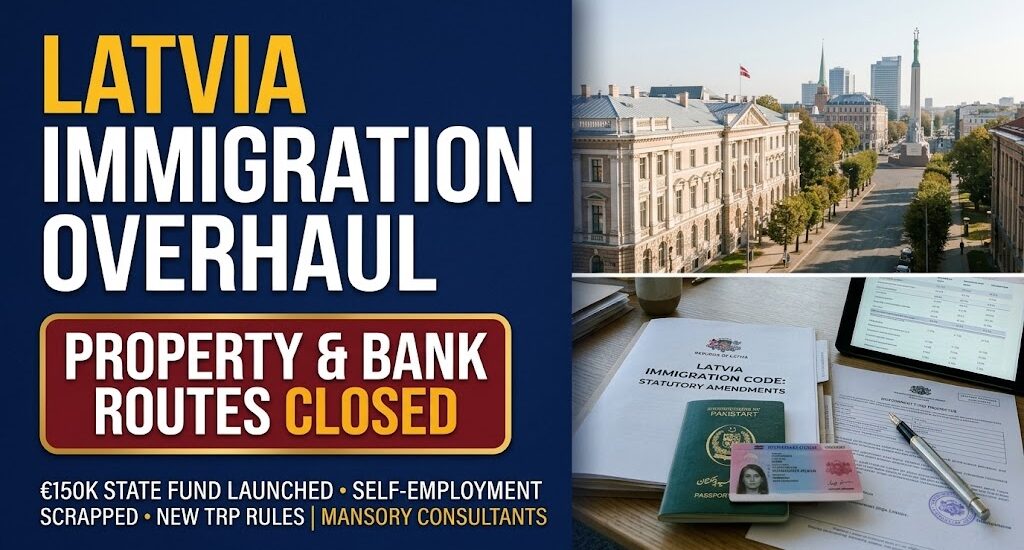
In one of the most comprehensive European immigration restructurings of the year, the Republic of Latvia has enacted a sweeping overhaul of its statutory Immigration Law (Imigrācijas likums). Formally passed by the Latvian Parliament (Saeima) and enacted into full legal force, the reform replaces the decades-old immigration framework of 2002. The new legislation fundamentally reconfigures the Baltic Schengen nation’s residence-by-investment landscape, employment sponsorship criteria, and temporary residence permit (TRP) frameworks.
Driven by a combination of national security considerations, European Union regulatory alignment, and efforts to eliminate “paper residency” vehicles, the new law signals a clear policy shift: Latvia is dismantling passive capital routes in favor of actively audited, state-monitored, and economically productive immigration channels.
For international investors, entrepreneurs, corporate professionals, and skilled third-country nationals navigating European mobility, these amendments reshape compliance standards across the Schengen Area.
                 [Latvia's 2026 Statutory Immigration Overhaul]
                                       │
        ┌──────────────────────────────┼──────────────────────────────┐
        ▼                              ▼                              ▼
[Abolished Pathways]            [New & Restricted Routes]     [Systemic Administrative Shifts]
• Real Estate (€250K) shut down • €150,000 State Fund created  • Annual card registration ended
• Bank Subordinated Deposits out • Business Share Capital: 2 yrs• TRP validity matches physical card
• Self-Employed status scrapped • +€10,000 State Budget fee    • Mandatory 4-month processing cap
• Sole Proprietors barred       • EU Blue Card & Startups intact• Integration rules set for late 2027
1. The Death of Legacy Golden Visas: Real Estate & Subordinated Deposits Abolished
For more than a decade, Latvia’s Real Estate Residence Scheme (requiring a minimum property purchase of €250,000) was one of Europe’s most widely accessed Golden Visa gateways. Alongside it, the subordinated banking capital deposit pathway (requiring €280,000 placed in a qualifying Latvian credit institution) provided a zero-maintenance residence option.
Under the new statutory framework, both pathways have been completely abolished for new applicants:
- Zero New Filings: As of the enactment date, the Office of Citizenship and Migration Affairs (OCMA / PMLP) no longer accepts initial temporary residence permit applications based on property acquisition or subordinated bank lending.
- Grandfathering and Transitional Protections: Foreign nationals who secured their residence permits under the real estate or bank deposit schemes prior to the cut-off date maintain their legal status until their current cards expire. Transitional provisions permit existing permit holders a single, final renewal window for an additional five-year term, provided all underlying real property or deposit criteria remain unencumbered and in full compliance.
2. The New €150,000 State-Established Investment Fund Route
To replace the discontinued passive channels without forfeiting foreign capital entirely, Latvia has introduced a state-controlled investment framework.
- Capital Requirement: Foreign applicants must invest a minimum of €150,000 for a locked term of at least five years through an officially certified, state-established alternative investment fund manager.
- Mandatory State Fee: In addition to the principal investment, applicants must pay a non-refundable €10,000 contribution directly into the Latvian state budget.
- Five-Year Residence Permit: The fund route grants an initial five-year temporary residence permit (TRP). Throughout the permit’s duration, the fund manager must certify annually to migration authorities that the investor’s balance has not dropped below the statutory €150,000 threshold.
- Exclusions: Under strict statutory security provisions, citizens of the Russian Federation and the Republic of Belarus are explicitly excluded from accessing this new investment pathway.
3. Corporate Share Capital Investment: Validity Halved
The pre-existing investment route via corporate share capital in an operating Latvian enterprise remains legally operational, but its parameters have been noticeably tightened:
- Capital Tiers: Investors can inject either €50,000 into a small enterprise (up to 50 employees and annual turnover under €10 million, with a maximum of 10 foreign investors permitted per company) or €100,000 into a larger commercial entity, supplemented by a €10,000 state-budget duty.
- Permit Duration Cut to Two Years: While previous bylaws granted up to a five-year TRP, permits under the business equity route are now granted for a maximum of two years.
- Annual Tax Generation Test: For a permit to be extended upon expiry, the target Latvian company must verify that it paid at least €40,000 annually in domestic taxes (or €100,000 for the larger corporate bracket), preventing shell-company abuse.
          [Comparison: Latvian Residency-by-Investment Pathways]
                                     │
      ┌──────────────────────────────┴──────────────────────────────┐
      ▼                                                             ▼
[State Investment Fund Option]                              [Company Share Capital Option]
• Minimum Investment: €150,000 locked for 5 years          • Minimum Investment: €50,000 or €100,000
• Non-refundable state budget levy: €10,000                  • Non-refundable state budget levy: €10,000
• TRP Validity Granted: Full 5 Years                        • TRP Validity Granted: 2 Years (down from 5)
• Managed passively via certified state funds                 • Target firm must pay €40,000+ in taxes/year
4. The Abolition of the Self-Employed Category
Perhaps the most disruptive operational shift for independent professionals, digital nomads, and sole proprietors is the total abolition of the self-employment immigration category.
Historically, foreign nationals could secure a temporary residence permit by registering as an individual merchant or self-employed person in Latvia. The new law eliminates this ground entirely:
- No Renewals for Existing Holders: Current holders of self-employed TRPs cannot renew their permits under that category once they expire.
- Mandatory Transition: Freelancers and sole traders must either transition their status to another legal ground—such as incorporating an operating company, qualifying for the Latvian Startup Visa, securing full-time employment via an EU Blue Card, or enrolling in an accredited academic program—or depart the country.
5. Modernized Procedural and Administrative Rules
Beyond category closures, the new immigration code introduces procedural modernizations designed to enhance system predictability:
- End of Annual Card Registration: Previously, a 5-year permit required holders to physically re-register and validate their ID card with migration authorities every 12 months. This recurring annual registration requirement has been scrapped. Instead, the legal duration of the TRP now directly matches the expiration date printed on the physical residence card.
- Strict 4-Month Processing Cap: Addressing long-standing bureaucratic delays where security screenings could stretch decision timelines up to a full year, the law imposes a statutory rule: total processing times, including all security extensions, may not exceed four months from document submission.
- Enhanced Permanent Residence (PR) Upgrades: Latvia has harmonized its dual permanent residence system into a unified EU Long-Term Residence Permit. Crucially, applicants no longer need to prove continuous, active local monthly salary income; they can satisfy the financial maintenance test solely through verified savings and liquid assets.
- Mandatory Integration Benchmark (Late 2027): Starting December 31, 2027, foreign residents holding consecutive TRPs totaling 18 months or more will be legally required to complete basic Latvian language, history, and civic integration courses.
6. Strategic Takeaways for International Applicants
The Latvian reforms align with a broader European trend seen in Spain, Portugal, Greece, and Ireland: the phase-out of passive real-estate golden visas in favor of focused, high-value, and legally transparent investment and employment routes.
At Mansory Consultants, our European corporate mobility and immigration desk advises cross-border investors and international executives to audit their existing residence pathways, restructure sole-trader profiles into compliant corporate corporate frameworks, and evaluate verified alternative routes across the Schengen Area