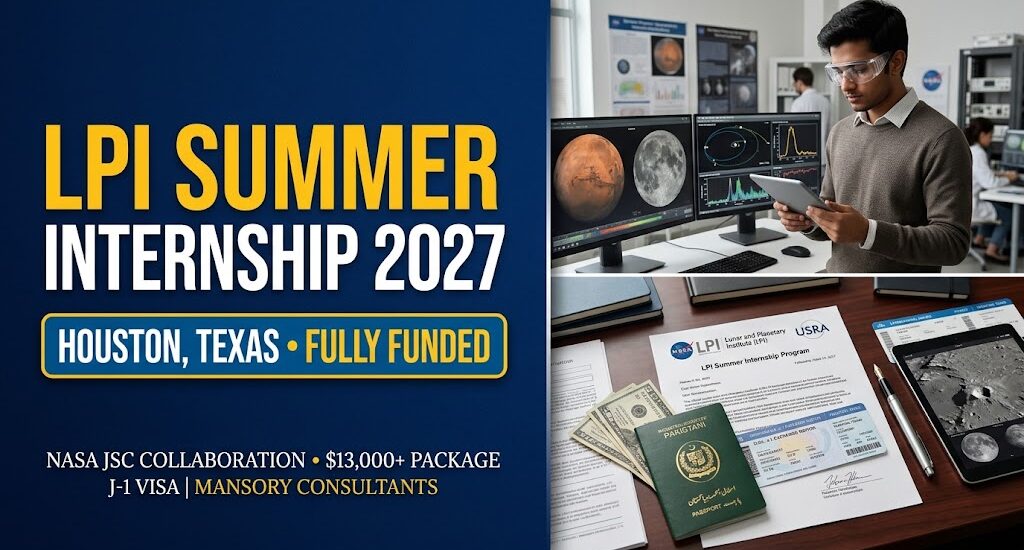
For undergraduate students pursuing degrees in physical sciences, engineering, computer science, and mathematics, one of the most elite research fellowships in the world has opened its application window.
The Lunar and Planetary Institute (LPI)—managed by the Universities Space Research Association (USRA) in close operational collaboration with NASA’s Lyndon B. Johnson Space Center (JSC)—is accepting applications for the LPI Summer Intern Program in Planetary Science 2027 in Houston, Texas.
Spanning 10 intensive weeks from June 7 to August 13, 2027, this fully funded, competitive program pairs promising undergraduate researchers directly with world-class planetary scientists, astrophysicists, and NASA research mentors. Interns contribute to active NASA robotic missions, analyze lunar Apollo and Artemis analogues, study Martian geomorphology, and process planetary spectral data.
Selected international fellows receive an extensive financial award totaling up to $13,350 to $13,600+, providing a substantial living stipend, fully covered corporate intern housing, and round-trip international airfare, backed by official J-1 Exchange Visitor Visa sponsorship.
At Mansory Consultants, our international academic mobility and overseas research desk assists candidates in preparing peer-level Statements of Purpose, auditing academic transcripts, and securing consular U.S. exchange visa appointments. Below is the operational legal blueprint detailing research areas, financial allowances, selection criteria, and application milestones for the 2027 cohort.
LPI Summer Intern Program 2027 at a Glance
| Program Parameter | Official LPI & NASA Institutional Specification |
| Host Institution | Lunar and Planetary Institute (LPI / USRA) |
| Research Partner | NASA Lyndon B. Johnson Space Center (JSC), Houston, Texas |
| Program Duration | 10 Weeks Full-Time (June 7 – August 13, 2027) |
| Financial Support Package | Up to $13,351 – $13,639 Total Coverage (Stipend, Housing, Airfare) |
| Direct Living Stipend | Dedicated cash stipend component for day-to-day subsistence |
| Accommodation | Fully arranged & subsidized housing near the Houston campus |
| Travel Allowance | Round-trip international flight / travel expense coverage |
| Conference Incentive | Up to $1,500 travel grant for first-author abstracts at LPSC |
| Visa Category | U.S. J-1 Exchange Visitor Visa (DS-2019 sponsored) |
| Application Deadline | December 14, 2026 (11:59 PM U.S. Central Time) |
| Notification of Results | March 2027 |
| Advisory & File Audits | Mansory Consultants Global Research Mobility Desk |
1. Research Areas: Contributing to NASA Planetary Science
Interns do not engage in simulated classroom exercises; they are embedded directly into active planetary research labs. Research projects span:
- Lunar Exploration & Science: Investigating South Pole-Aitken Basin geology, lunar regolith physical characteristics, and volatile ice trapping in permanently shadowed regions (supporting NASA’s Artemis program).
- Planetary Geochemistry & Sample Return: Petrographic and isotopic analysis of meteorites, asteroid Bennu samples returned by OSIRIS-REx, and cosmic dust grains.
- Mars Surface Processes & Remote Sensing: Interpreting orbital radar, spectroscopy, and imaging data from the Mars Reconnaissance Orbiter (MRO) and rover datasets (Perseverance/Curiosity).
- Astrobiology & Icy Ocean Worlds: Modeling thermal convection, cryovolcanism, and habitability environments on Europa, Enceladus, and Titan.
- Machine Learning in Space Science: Deploying neural networks, AI computer vision, and algorithmic automation to map impact crater distributions and celestial body morphology.
2. Comprehensive Financial Coverage Breakdown
The financial support structure ensures that financial need does not prevent eligible students from participating:
                [Total Program Financial Package: Up to $13,600+]
                                        │
        ┌───────────────────────────────┼───────────────────────────────┐
        ▼                               ▼                               ▼
[Direct Living Stipend]        [Corporate Intern Housing]     [International Travel]
• Liquid bi-weekly cash payout • Subsidized, fully furnished   • Round-trip airfare reimbursed
• Covers meals, transit & local  apartments near LPI/NASA JSC   or booked directly by USRA
  incidentals in Houston       • Utilities & Wi-Fi included    • Airport transfers covered
- Additional LPSC Conference Grant: Interns who complete their research and have an abstract accepted as first author at the subsequent Lunar and Planetary Science Conference (LPSC) can receive up to $1,500 in supplemental travel funding to present their findings to international scientists.
3. Eligibility Criteria for International Applicants
To qualify for the 2027 selection cycle, applicants must meet specific academic and legal requirements:
- Academic Standing: Must be an undergraduate student currently enrolled in an accredited bachelor’s degree program.
- Credit Threshold: Must have successfully completed at least 50 semester credit hours (or equivalent collegiate coursework) by the start of the summer program.
- Eligible Fields of Study: Majors in Physical Sciences, Natural Sciences, Engineering (Mechanical, Aerospace, Electrical, Materials), Computer Science, Geosciences, or Mathematics are prioritized.
- Enrolled Preceding Summer: Applicants must maintain undergraduate enrollment status during the semester immediately preceding the internship. (Students graduating before the internship begins are ineligible).
- English Language Proficiency: International applicants can satisfy English language verification through:
- IELTS Academic or TOEFL iBT official scorecards, OR
- An institutional letter from a professor in the applicant’s university English/Humanities department certifying professional written and spoken English fluency.
- Nationality & Security Compliance: Open to foreign nationals worldwide, excluding citizens of states appearing on the U.S. Department of State designated-country restrictions list.
4. Mandatory Application Dossier & Selection Strategy
The selection committee receives hundreds of global applications for a small number of fellowship seats. Applications are evaluated based on academic achievement, research alignment, and scientific curiosity:
[Online Application Form & Project Preference Ranking on USRA/LPI Portal]
                                      │
                                      ▼
[Official University Transcripts (Detranscribing 50+ Completed Credit Hours)]
                                      │
                                      ▼
[Curriculum Vitae (CV) Highlighting Lab Proficiencies, Coding & Projects]
                                      │
                                      ▼
[Essay Responses Detailing Scientific Objectives & NASA Project Alignment]
                                      │
                                      ▼
[2 to 3 Confidential Letters of Recommendation Submitted Online by Referees]
Critical Success Factors for the Essay Section:
- Avoid General Statements: Do not write generic essays stating a childhood dream of working for NASA. Focus on concrete coursework, data analysis libraries (e.g., Python, MATLAB, GIS), laboratory instrumentation experience, and specific papers published by LPI/JSC scientists.
- Match Project Capabilities: The online portal requires applicants to review proposed summer research projects and designate preferences. Clearly articulate how your current technical skill set aligns with those specific investigations.
5. The Consular Phase: J-1 Exchange Visitor Visa Processing
Once an offer is accepted in March 2027, international fellows must secure legal entry into the United States:
- Form DS-2019 Issuance: The host organization (USRA/LPI) issues the official Certificate of Eligibility for Exchange Visitor Status (Form DS-2019) designating you as a J-1 Short-Term Scholar / Student Intern.
- SEVIS I-901 Fee: The Student and Exchange Visitor Information System fee must be settled online.
- DS-160 Filing & Consular Interview: Complete the online DS-160 visa dossier and schedule an expedited biometric and consular interview at the U.S. Embassy in Islamabad or U.S. Consulate in Karachi.
- Proving Non-Immigrant Intent: As an exchange scholar, you must present your official university enrollment in Pakistan, confirming that you are required to return to your home institution to complete your undergraduate degree after the 10-week fellowship concludes.
Secure Your Global Research Fellowship with Mansory Consultants
Gaining admission to a NASA-affiliated research institute requires a well-structured application strategy. A weak research essay or delays in foreign exchange visa processing can derail your placement.
At Mansory Consultants, our international academic mobility and consular visa desk delivers:
- In-depth profile evaluations matching your undergraduate engineering, computer science, or physics coursework with LPI project listings.
- Expert review and editing of research statements and academic CVs.
- Document attestation and transcript organization meeting U.S. institutional guidelines.
- Complete preparation for the U.S. Embassy J-1 Exchange Visitor Visa interview, including DS-160 auditing, SEVIS processing, and home-tie substantiation.
The December 14, 2026 application deadline requires early preparation. Contact Mansory Consultants today to start your application for the LPI Summer Intern Program 2027 in the United States