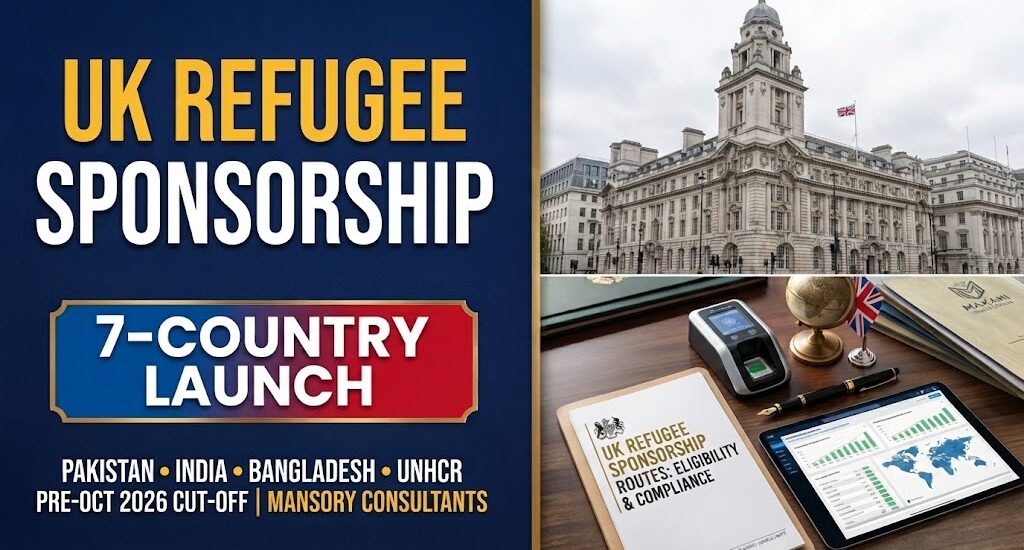
The UK Home Office has officially launched three new safe and legal refugee sponsorship routes operating in a phased rollout across seven initial countries, including Pakistan, Bangladesh, India, Malaysia, Egypt, Uganda, and Kenya.
Announced by the Minister of State for Border Security and Asylum, Anna Turley, the policy initiative is structured to dismantle irregular channel smuggling models by providing controlled, regulated entry frameworks. The scheme encompasses three key pathways—Named Community Sponsorship, the Refugee Study Route, and the Refugee Work Route—with the first arrivals anticipated in autumn 2027.
                 [UK Safe & Legal Refugee Sponsorship Architecture]
                                          │
        ┌─────────────────────────────────┼─────────────────────────────────┐
        ▼                                 ▼                                 ▼
[The 7 Initial Countries]          [The 3 Core Pathways]             [Primary Eligibility Cut-Off]
• Pakistan                         • Named Community Sponsorship     • Must be outside country of origin
• India & Bangladesh               • Refugee Study Route (Uni offers)• Registered with UNHCR or local
• Egypt, Kenya & Uganda            • Refugee Work Route (Job offers) • Authorities BEFORE 1 October 2026
• Malaysia                         • Managed via accredited leads    • Strict Home Office security audits
1. Core Eligibility and the Strict October 1, 2026 Cut-Off Date
To safeguard the integrity of the new legal routes, the Home Office has instituted rigorous baseline criteria for prospective applicants:
- Territorial Requirement: The routes are strictly not open to nationals residing in their country of origin. Applicants must be physically located outside their country of nationality (or former habitual residence if stateless).
- Mandatory Prior Registration: To qualify for consideration under the Pakistan rollout or other partner nations, individuals must have been present and formally registered with relevant host-state authorities or the United Nations High Commissioner for Refugees (UNHCR) prior to October 1, 2026.
- Refugee Status Verification: Applicants must be recognized as refugees by the competent authority or verified by the UNHCR as meeting the definition under the 1951 Refugee Convention (or alternative Home Office-assessed processes for specific regional groups like Palestinian refugees under UNRWA mandates).
2. The Three Operational Pathways
Unlike generalized resettlement streams, these pathways depend on active UK-based sponsorship infrastructure to facilitate integration:
- Named Community Sponsorship: Enables local community groups and civic charities to sponsor specific refugee families, providing direct housing, social orientation, and integration support upon arrival.
- Refugee Study Route: Allows participating British universities and higher education institutions to sponsor verified refugees to pursue academic degree programs.
- Refugee Work Route: Empowers approved UK corporate sponsors to offer formal employment contracts to eligible candidates, integrating them directly into the domestic labor market.
                 [The Sponsorship & Application Verification Pipeline]
                                            │
                                            ▼
           [Refugee Registered with UNHCR / Authorities Before Oct 1, 2026]
                                            │
                                            ▼
           [Matched via Lead Sponsor with UK Community Group, University, or Employer]
                                            │
        ┌───────────────────────────────────┴───────────────────────────────────┐
        ▼                                                                       ▼
[Sponsor Compliance Checks]                                   [Home Office Statutory Screening]
• Lead sponsor reviews documentation                          • Biometric enrollment & health checks
• Safeguarding policies verified                              • Rigorous identity & security vetting
• Accommodation & support plan secured                        • Final clearance grants 5-year UK leave
3. Strict Vetting, Security, and Leave Conditions
Meeting preliminary country presence and registration criteria does not guarantee entry. Every candidate is subject to strict pre-departure screening:
- Comprehensive Vetting: All applicants must complete mandatory biometric enrollment, medical examinations, and robust identity, security, and suitability checks administered by Home Office caseworkers.
- Initial Leave Granted: Successful applicants approved for travel will receive an initial leave status to enter and reside in the UK under the respective sponsorship framework.