
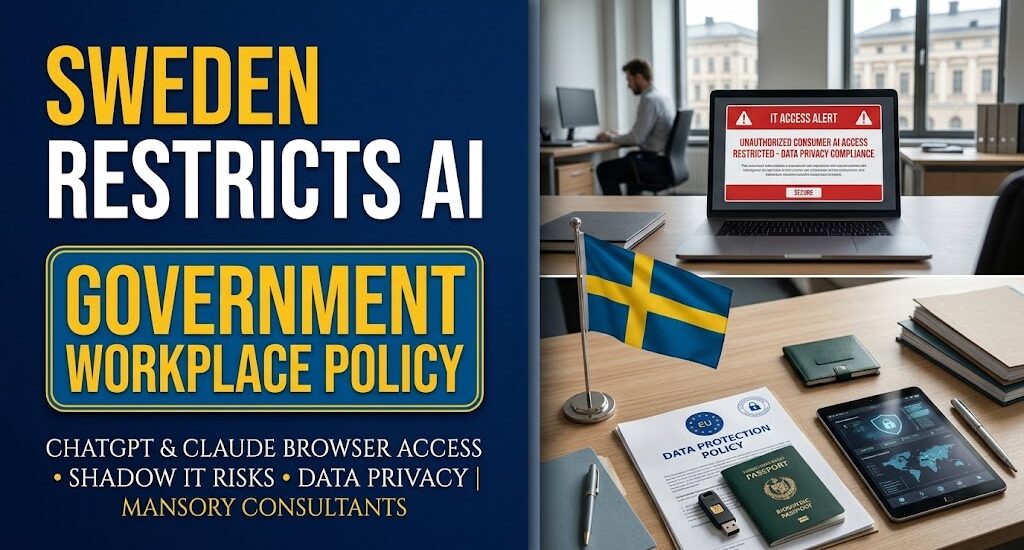
In a decisive move to secure sensitive state data and curb unvetted enterprise cloud workflows, the Swedish Government Offices (Regeringskansliet) have officially blocked browser-based access to commercial generative AI platforms—specifically OpenAI’s ChatGPT and Anthropic’s Claude—on civil servants’ official workstations and government computers.
The directive, which took effect on Monday, October 26, 2026, represents a proactive response to escalating information security risks. The primary regulatory driver is not a blanket opposition to artificial intelligence, but rather the absence of binding, audited data protection and data processing agreements (DPAs) governing public web-tier consumer chatbots.
Swedish Chief Information Officer (CIO) and Director of Digitization Mikael Wettercrantz warned that unmonitored “Shadow IT”—where government personnel paste internal memos, legislative drafts, or sensitive citizen records into unapproved web tools—poses severe consequences for Sweden’s national information sovereignty.
                [Sweden Public Sector AI Security Architecture]
                                       │
        ┌──────────────────────────────┼──────────────────────────────┐
        ▼                              ▼                              ▼
[Unapproved Public Web Chatbots] [The Shadow IT Threat Vector]  [Approved Enterprise Ecosystem]
• ChatGPT & Claude web blocked   • Uncontrolled prompt uploads  • Enterprise Copilot allowed
• No binding DPA / EU contracts  • Risk of LLM training leaks   • Dedicated internal AI platform
• Joins DeepSeek on blocklist    • Third-party server processing• Strict GDPR & EU AI Act parity
1. The Core Threat: Shadow IT and Data Sovereignty
Under standard consumer terms of service, text entered into browser-based AI portals may be transmitted to foreign data centers and potentially repurposed for model fine-tuning. For public administrative bodies handling confidential state files, immigration records, and civic policy data, this presents three major compliance conflicts:
- GDPR Compliance Risks: Transferring personal citizen data to external third-party cloud architectures without formal Data Processing Agreements violates European General Data Protection Regulation (GDPR) mandates.
- EU AI Act Alignment: With the EU AI Act enforcing strict transparency, risk classification, and literacy standards across public bodies, government operations must maintain clear auditability for automated data processing.
- Foreign Cloud Exposure: Unchecked routing of European public administrative inquiries through US-headquartered consumer platforms creates foreign jurisdiction dependencies and cloud privacy liabilities.
2. The Exemption: Governed Enterprise Platforms vs. Public Portals
Swedish officials emphasized that the measure is a workplace endpoint policy for government employees, not a nationwide ban for private citizens, commercial enterprises, or research universities.
Furthermore, access to advanced AI remains accessible within government through tightly governed channels:
- Enterprise Microsoft Copilot Retained: Solutions operating under secured corporate enterprise licensing—where telemetry, logging, and model-training opt-outs are contractually guaranteed—remain authorized for public sector tasks.
- Dedicated Government AI Sandboxes: A select tier of public servants requiring generative capabilities retains access to ChatGPT and Claude models through a specialized, isolated internal assistant platform configured specifically for the Government Offices.
                 [The Nordic Playbook: Regulating AI in Workplaces]
                                        │
                                        ▼
             [Step 1: Discover Internal AI Usage & Map Shadow IT]
                                        │
                                        ▼
             [Step 2: Require Binding Data Protection Agreements (DPAs)]
                                        │
        ┌───────────────────────────────┴───────────────────────────────┐
        ▼                                                               ▼
[Vendors Without Compliant DPAs]                              [Enterprise Compliant Solutions]
• Block browser-level access on endpoints                      • Deploy secured enterprise licenses
• Prohibit pasting confidential records                        • Ensure zero model-training on inputs
• Log and audit connection attempts                            • Maintain local / EU data storage
3. Implications for European Migration & Consular Advisory
As Nordic governments tighten administrative cybersecurity, the modernization extends across consular registries, the Swedish Migration Agency (Migrationsverket), and regional educational boards:
- Automated Document Screening: The shift toward compliant, audited software means European consular posts and immigration databases are adopting zero-tolerance validation protocols for legal files, visa applications, and academic credentials.
- Confidentiality in Study & Work Portfolios: Applicants and international professionals navigating European study visas, residence permits, and employment sponsorships must ensure their personal identification and financial records are handled with enterprise-grade data security.
At Mansory Consultants, our international education and immigration intelligence desk tracks evolving regulatory frameworks across Sweden and the European Union, ensuring student and corporate dockets meet the highest standards of legal compliance and institutional integrity