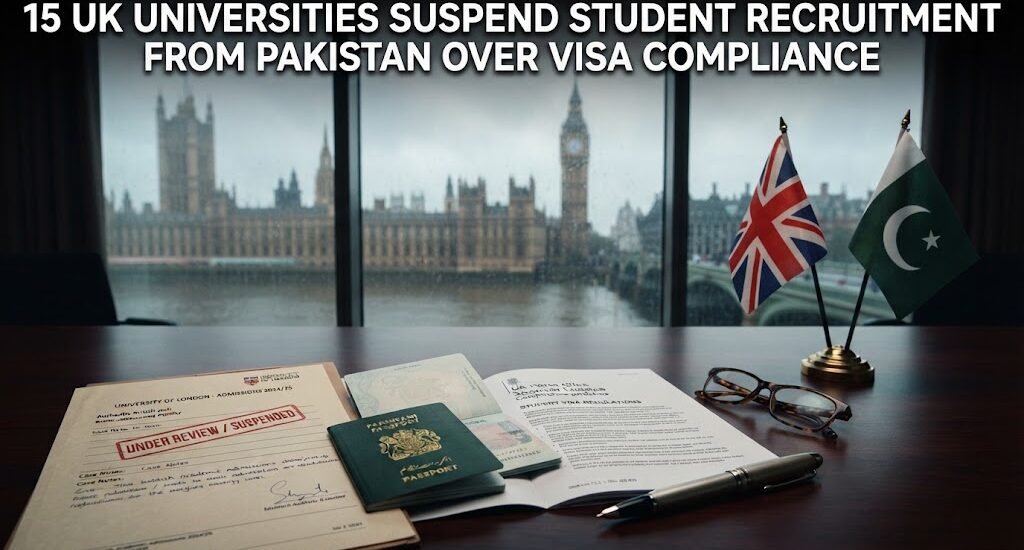
15 UK UNIVERSITIES SUSPEND STUDENT RECRUITMENT FROM PAKISTAN OVER VISA COMPLIANCE
In a shift across the British international education sector, approximately 15 United Kingdom universities have paused or suspended direct international student recruitment from Pakistan.
The defensive policy comes in response to tighter statutory enforcement by the UK Home Office, which requires higher education institutions to maintain strict compliance thresholds or face the revocation of their Student Sponsor Licences.
Under British immigration law, universities holding sponsor status must keep their overall student visa refusal rate strictly below 5%.
Exceeding this regulatory ceiling triggers formal audits, sanctions, and potential suspension of an institution’s ability to issue Confirmation of Acceptance for Studies (CAS) letters.
An analysis of official Home Office data conducted by the Financial Times revealed that the share of withdrawn student visa applications from Pakistan surged to 40.9% in the first half of 2026, compared to just 3% during the same period in 2025.
To protect their multi-million-pound recruitment pipelines across other international markets, several universities—particularly post-1992 institutions and mid-tier regional academies—have enacted pre-emptive country-specific bans, withdrawn existing conditional admission offers, or instituted enhanced credibility checks before releasing CAS documentation.
Here is an analysis of why institutions are suspending Pakistani intake, the mechanics of Home Office sponsor compliance, affected degree levels, and actionable advice for genuine applicants navigating UK admissions.
The Compliance Dilemma: Why UK Institutions Are Halting Intake
The wave of institutional freezes is a calculated measure to avoid severe Home Office penalties:
          HOME OFFICE COMPLIANCE VS. SPONSOR LICENCE THREATS
 ┌─────────────────────────────────────────────────────────────┐
 │ 🏛️ THE 5% VISA REFUSAL CEILING                              │
 │ UK universities must keep student visa rejections under 5%. │
 │ Crossing this threshold triggers Basic Compliance Audits    │
 │ and can revoke an institution's Student Sponsor Licence.    │
 ├─────────────────────────────────────────────────────────────┤
 │ 📈 40.9% APPLICATION WITHDRAWAL SURGE (HOME OFFICE DATA)    │
 │ In H1 2026, over 40% of Pakistani study visa applications    │
 │ were withdrawn or flagged—often tied to document doubts,    │
 │ asylum claims, or course non-commencement warnings.         │
 ├─────────────────────────────────────────────────────────────┤
 │ 🛑 PROACTIVE INSTITUTIONAL DEFENSE                          │
 │ Universities are freezing recruitment from specific hubs    │
 │ to isolate their institutional refusal metrics from spikes. │
 └─────────────────────────────────────────────────────────────┘
(Sources:)
Universities rely heavily on international tuition revenue. However, losing a sponsor licence eliminates all non-UK student recruitment across every faculty, presenting an existential financial risk that far outweighs the benefit of continuing admissions from regions flagged as high-risk by the Home Office.
Key Operational Benchmarks & Home Office Data Trends
| Compliance Metric | Previous Benchmark (2025) | Current Operational Level (2026) | Regulatory Implication |
|---|---|---|---|
| Pakistani Application Withdrawal Rate | ~3.0% | 40.9% Surge | Triggered nationwide risk audits across UK universities. |
| Institutions Halting/Restricting Intake | Limited individual checks | Approximately 15 Universities | Pre-emptive recruitment pause for upcoming intakes. |
| Statutory Visa Refusal Limit | Must stay below 5% | Strictly Monitored 5% Cap | Breach results in loss of international recruiting rights. |
| Average Study Visa Withdrawn Rate | 2.3% globally | 10.5% Global Average | Reflects broader Home Office immigration crackdowns. |
| Associated Markets Facing Curbs | Minimal restrictions | Nigeria (22.7%), Bangladesh (23.5%) | Multi-nation tightening targeting compliance vulnerabilities. |
Primary Factors Driving Pakistani Visa Scrutiny
British immigration officials and university compliance departments have identified three recurring triggers behind the heightened scrutiny:
               PRIMARY FACTORS IN APPLICATION SCRUTINY
 ┌─────────────────────────────────────────────────────────────┐
 │ 📑 FINANCIAL CREDIBILITY & THIRD-PARTY BANK STATEMENTS      │
 │ High rates of unverified third-party funds, temporary bank  │
 │ deposits, and non-compliant financial maintenance proofs.   │
 ├─────────────────────────────────────────────────────────────┤
 │ ⚖️ ASYLUM & POST-ARRIVAL STATUS TRANSITIONS                 │
 │ Rising instances of students claiming asylum or attempting  │
 │ in-country visa switching shortly after entering the UK.    │
 ├─────────────────────────────────────────────────────────────┤
 │ 🗣️ CREDIBILITY INTERVIEWS & STUDY INTENT GAPS               │
 │ Inability during UKVI / university pre-CAS interviews to     │
 │ explain course modules, future career plans, or finances.   │
 └─────────────────────────────────────────────────────────────┘
(Sources:)
Impact Across University Tiers: Who Is Pausing vs. Who Is Open?
The freeze is not a blanket UK government ban on Pakistani nationals; rather, it is an individual operational decision implemented by distinct universities:
- Regional & Modern Universities (Most Affected): Several modern post-1992 institutions that accepted high volumes of international foundation and conversion Master’s programs have paused intakes to protect their licences.
- The Russell Group & Research-Intensive Institutions (Still Open): Premier research universities—such as Manchester, Edinburgh, Warwick, and King’s College London—continue to accept academically qualified Pakistani applicants. However, they enforce stringent entry criteria, including higher IELTS thresholds, established prior academic records, and strict scrutiny of genuine temporary entrant (GTE) criteria.
- Enhanced Pre-CAS Vetting Everywhere: Institutions that remain open have introduced secondary internal screening, including video credibility interviews, independent verification of bank statements, and requests for higher upfront tuition fee deposits before CAS issuance.
Strategic Roadmap for Genuine Pakistani Applicants
Prospective students aiming to study in the UK can take concrete steps to ensure their applications remain secure:
               ACTION CHECKLIST FOR GENUINE STUDENTS
 ┌─────────────────────────────────────────────────────────────┐
 │ 1. TARGET HIGH-COMPLIANCE, RESEARCH-LED INSTITUTIONS        │
 │ Direct applications toward established universities with    │
 │ robust global rankings and established CAS track records.   │
 ├─────────────────────────────────────────────────────────────┤
 │ 2. PREPARE 28-DAY MAINTAINED FINANCIAL RECORDS              │
 │ Use clean, mature personal or parental bank accounts with   │
 │ continuous holding periods; avoid sudden, unverified loans. │
 ├─────────────────────────────────────────────────────────────┤
 │ 3. MASTER YOUR COURSEWORK & CREDIBILITY INTERVIEW           │
 │ Be prepared to articulate your exact syllabus, tuition fees,│
 │ career trajectory, and return-on-investment timeline.       │
 ├─────────────────────────────────────────────────────────────┤
 │ 4. CONFIRM CAS AVAILABILITY BEFORE PAYING DEPOSITS          │
 │ Request explicit written confirmation from university       │
 │ admissions teams that CAS will be released for your intake. │
 └─────────────────────────────────────────────────────────────┘
(Sources:)
Higher Education Advisory & Student Compliance Strategy
Navigating UKVI immigration compliance, selecting universities with secure sponsor licences, and auditing financial statements and credibility interviews requires specialized guidance. Prospective undergraduate and postgraduate scholars seeking institutional shortlisting, document audits, and genuine student visa processing can consult mansoryconsultants.
📌 Immigration Advisory: Visa issuance criteria and sponsor compliance quotas are governed under the sovereign statutory authority of the UK Home Office and UK Visas and Immigration (UKVI). University admission policies, CAS allocations, and country-specific pauses remain at the discretion of individual academic governing boards