
Specific Subject Requirements: Mathematics, Physics, and Chemistry for Swedish Admissions 🇸🇪📐🔬⚛️
In the centralized Swedish higher education system on UniversityAdmissions.se, clearing general eligibility (Grundläggande behörighet)—holding a recognized secondary diploma or Bachelor’s degree, passing English 6, and completing document attestations—is only the initial hurdle.
For the majority of science, technology, engineering, mathematics (STEM), business, and medical degree programs across institutions like KTH Royal Institute of Technology, Chalmers University of Technology, Lund University, Uppsala University, and Linköping University, entry hinges on satisfying Specific Entry Requirements (Särskild behörighet).
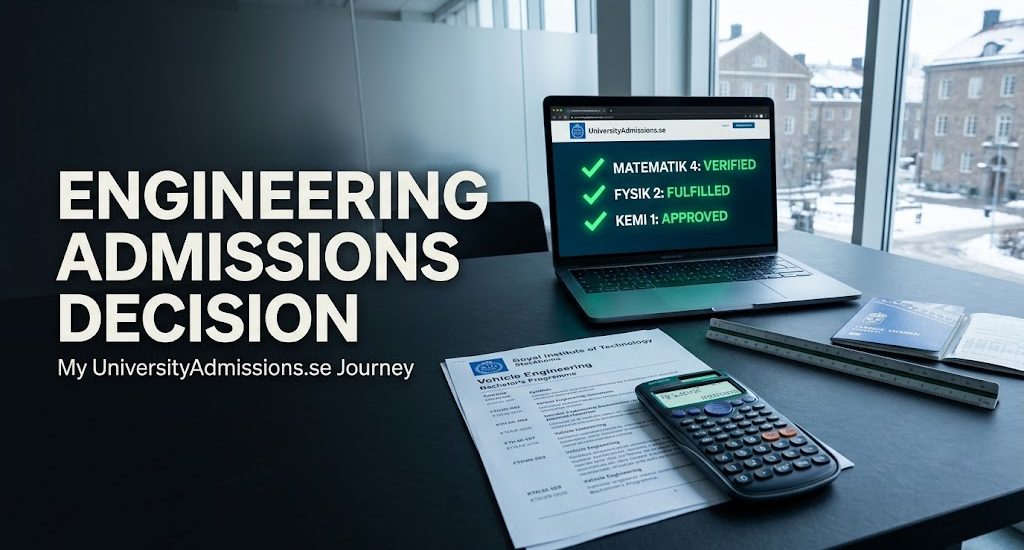
Administered by the Swedish Council for Higher Education (Universitets- och högskolerådet – UHR), specific requirements are calibrated against the Swedish upper secondary school curriculum (Gymnasieskolan). Degree catalogs stipulate prerequisites using standardized designations such as Matematik 4, Fysik 2, or Kemi 1.
If an applicant’s transcripts fail to demonstrate the exact course content, laboratory hours, and theoretical scope matching these levels, the admissions portal automatically flags the application as “Unqualified” (Ej behörig)—regardless of how high the applicant’s cumulative GPA or standardized English scores are.
Here is the comprehensive guide to decoding Swedish specific subject requirements in Mathematics, Physics, and Chemistry, mapping foreign qualifications, and securing prerequisite verification before the 1 February document deadline.
The Swedish Gymnasial Course Level Architecture
In the Swedish high school system, foundational sciences and mathematics are organized into sequential, credit-weighted course tiers:
               THE SWEDISH STEM SUBJECT PROGRESSION
 ┌─────────────────────────────────────────────────────────────┐
 │ MATHEMATICS:                                                │
 │ • Matematik 1 (1a/1b/1c) ──► General high school math      │
 │ • Matematik 2 (2a/2b/2c) ──► Intermediate algebra & stats   │
 │ • Matematik 3 (3b/3c)    ──► Differential calculus basics   │
 │ • Matematik 4            ──► Trigonometry & integral calc   │
 │ • Matematik 5 / Spec.    ──► Linear algebra & diff equations│
 └─────────────────────────────────────────────────────────────┘
 ┌─────────────────────────────────────────────────────────────┐
 │ NATURAL SCIENCES:                                           │
 │ • Fysik 1a / 1b ──► Mechanics, thermodynamics, waves        │
 │ • Fysik 2       ──► Atomic physics, electromagnetism, optics│
 │ • Kemi 1        ──► Stoichiometry, bonding, thermochemistry │
 │ • Kemi 2        ──► Organic synthesis, kinetics, equilibrium│
 └─────────────────────────────────────────────────────────────┘
1. Mathematics Requirements Decoded (Matematik 1 to 5)
Mathematics is the most frequently audited prerequisite across both Bachelor’s and Master’s programs.
| Swedish Course Level | Target Academic Programs | Curriculum Content Evaluated by UHR | Foreign Qualification Equivalents |
| Matematik 1 (1a/1b/1c) | Humanities, Arts, Basic Social Sciences | Arithmetic, percentages, linear equations, basic geometry, simple statistics. | • Pakistani SSC / Matric General Math • Cambridge IGCSE / O-Level Math (Grade C/4+) • Indian ICSE / CBSE Class 10 Math |
| Matematik 2 (2a/2b/2c) | International Business, Economics, Management | Quadratic equations, linear systems, logarithm rules, normal distribution, financial math. | • Pakistani HSSC / I.Com Business Math & Stats • AS-Level Mathematics • US High School Algebra II + Pre-Calculus |
| Matematik 3 (3b/3c) | Finance, Data Science, Architecture, Informatics | Polynomial division, derivatives, tangents, curve sketching, basic anti-derivatives. | • Pakistani HSSC / FSc Pre-Engineering Math (Part-I) • Cambridge A-Level Math (Pure Math 1) • IB Math: Analysis & Approaches SL |
| Matematik 4 | Computer Science, Software Engineering, Civil/Mech Eng | Trigonometric formulas, complex numbers, integrals, differential calculus, rate of change modeling. | • Complete Pakistani FSc Pre-Engineering / ICS Math • Cambridge A-Level Math (Full 4 modules: P1, P3, S1, M1) • IB Math: Analysis & Approaches HL |
| Matematik 5 / Advanced | Specialized MSc Engineering (KTH, Chalmers) | Matrix algebra, differential equations, vectors in 3D, combinatorics, proof by induction. | • Tertiary Bachelor’s Engineering Math (Linear Algebra + Multivariable Calculus: 15–30 ECTS) |
2. Physics Requirements Decoded (Fysik 1 and Fysik 2)
Technical engineering degrees at institutions like KTH, Chalmers, Lund LTH, and Uppsala require extensive secondary physics coursework.
Fysik 1 (Fysik 1a / 1b):
- Curriculum Coverage: Classical mechanics (kinematics, Newton’s laws, momentum, work, kinetic/potential energy), thermodynamics (heat capacity, phase changes, thermal expansion), electrical circuits (Ohm’s law, Kirchhoff’s laws), and wave mechanics (sound, resonance, reflection/refraction).
- Foreign Equivalents: Cambridge AS-Level Physics; Pakistani FSc Pre-Engineering Physics (Part-I / 11th Grade); Indian Class 11 Physics.
Fysik 2:
- Curriculum Coverage: Electric and magnetic fields (Lorentz force, electromagnetic induction, Faraday’s law), wave optics (diffraction, interference, polarization), modern/quantum physics (photoelectric effect, atomic spectra, de Broglie wavelength), and nuclear physics (radioactivity, mass defect, fission/fusion).
- Foreign Equivalents: Full Cambridge A-Level Physics (A2 level passed); Complete 2-year Pakistani FSc Pre-Engineering Physics (Part-I + Part-II with practical lab exams attested by IBCC); Indian CBSE/ISC Class 12 Physics.
⚠️ The Practical Laboratory Requirement: Under UHR rules, Fysik 2 requires confirmed experimental laboratory work. If an applicant presents high school qualifications where physics was tested purely theoretically without practical lab components, admissions evaluators may reject the equivalency.
3. Chemistry Requirements Decoded (Kemi 1 and Kemi 2)
Mandatory for programs in Chemical Engineering, Biotechnology, Molecular Biology, Environmental Sciences, and Biomedicine.
Kemi 1:
- Curriculum Coverage: Atomic structure, electron configurations, periodic trends, chemical bonding (ionic, covalent, metallic, intermolecular forces), the mole concept, stoichiometry, solution chemistry, and basic acid-base equilibria ($pH$ calculations).
- Foreign Equivalents: Cambridge AS-Level Chemistry; Pakistani FSc Pre-Engineering / Pre-Medical Chemistry (Part-I); Indian Class 11 Chemistry.
Kemi 2:
- Curriculum Coverage: Reaction kinetics (reaction rates, activation energy, catalysis), chemical equilibria ($K_c$, $K_p$, Le Chatelier’s principle), electrochemistry (galvanic/electrolytic cells, redox titration), organic chemistry (functional groups, reaction mechanisms, isomerism), and biochemistry foundations (proteins, lipids, carbohydrates, nucleic acids).
- Foreign Equivalents: Full Cambridge A-Level Chemistry (A2 passed); Complete 2-year Pakistani FSc Pre-Medical / Pre-Engineering Chemistry (Parts I & II verified by IBCC); IB Chemistry HL.
Prerequisites for Master’s Applicants: The Secondary-to-Tertiary Bridge
A frequent trap for international Master’s applicants is assuming that holding a Bachelor of Science (BSc) degree overrides secondary subject checks.
In the Swedish system, specific entry requirements for a Master’s degree can be framed in two distinct ways:
               HOW MASTER'S PREREQUISITES ARE STATED
 ┌─────────────────────────────────────────────────────────────┐
 │ CASE A: TERTIARY CREDIT SPECIFICATION (ECTS)                │
 │ • Example: "At least 30 ECTS in Mathematics, including      │
 │   Linear Algebra, Multivariable Calculus, and Statistics."  │
 │ • Proof: Official attested University Transcript + Syllabi. │
 └─────────────────────────────────────────────────────────────┘
                                OR
 ┌─────────────────────────────────────────────────────────────┐
 │ CASE B: SECONDARY BENCHMARK SPECIFICATION (Gymnasiekurs)    │
 │ • Example: "General entry requirements + Matematik 4."      │
 │ • Proof: Upper Secondary School Certificates (FSc / A-Level │
 │   / Matric) MUST be uploaded, even for Master's files!      │
 └─────────────────────────────────────────────────────────────┘
If a Master’s program syllabus lists Matematik 4 or Fysik 2 under its specific prerequisites, uploading your Bachelor’s degree alone will result in disqualification. You must upload your high school credentials (e.g., IBCC-attested Matric and Intermediate DMCs, or Cambridge certificates) to validate the secondary requirement.
Audit & Submission Protocol for UniversityAdmissions.se
To ensure your subject prerequisites are evaluated accurately by UHR and departmental committees:
- Submit Unbroken Multi-Year Marksheets: Ensure high school transcripts show course-by-course breakdowns across both years of study (e.g., FSc Part-I and Part-II DMCs). Consolidated single-line summary marksheets are rejected.
- Provide Course Syllabuses When Ambiguous: If your university transcript uses non-standard titles (e.g., “Applied Computational Tools” instead of “Linear Algebra”), attach an official, department-stamped course syllabus detailing the mathematical content.
- Ensure Complete Attestation: Pakistani secondary documents must carry IBCC verification tickets and stamps on the reverse side; Bachelor’s transcripts must carry HEC attestation barcodes.
- Observe the 1 February Deadline: All proof of prerequisites must be uploaded to the portal before 24:00 (Midnight) CET on 1 February. Evaluators will not consider documents submitted after this date during primary merit selection.
Strategic Corporate Advisory & Swedish Higher Education Governance
Navigating Sweden’s specific subject prerequisites, mapping non-European engineering curricula to gymnasial course tiers (Matematik 4, Fysik 2), and structuring compliant academic dossiers for university admissions and Migrationsverket residence permits requires rigorous procedural precision. International students, graduate researchers, and STEM candidates seeking specialized Swedish admissions advisory can consult Mansory Consultancy.
📌 Important Notice: Compiled from statutory admission directives published by the Swedish Council for Higher Education (Universitets- och högskolerådet – UHR) and UniversityAdmissions.se under Swedish Ordinance 2010:543. Subject equivalencies are assessed strictly against Swedish national gymnasial curricula; departments do not waive missing prerequisite mathematics or science courses.