
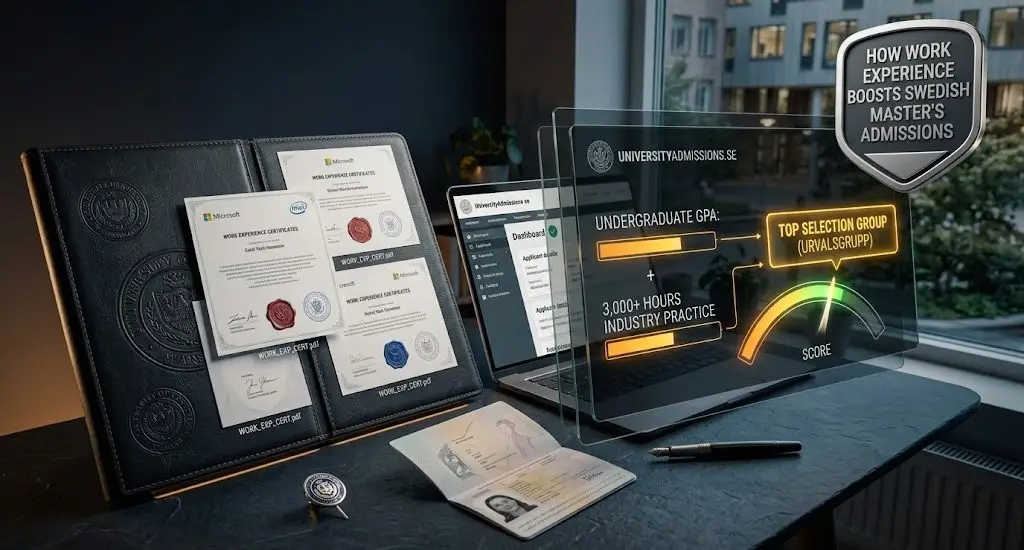
How Work Experience Certificates Boost Sweden Master’s Admissions 🇸🇪💼📈🎓
When international applicants evaluate their admission chances on UniversityAdmissions.se, attention naturally centers on undergraduate Cumulative GPA, credit hours (ECTS), and English 6 testing benchmarks. However, when competing for high-demand Master’s programs across Sweden’s top tier—such as KTH Royal Institute of Technology, Lund University, Uppsala University, Chalmers, and Stockholm University—thousands of applicants present near-identical top-percentile academic transcripts.
In these competitive scenarios, Work Experience Certificates (Tjänstgöringsintyg) serve as a critical differentiator.
While the Swedish Council for Higher Education (Universitets- och högskolerådet – UHR) evaluates general and specific eligibility criteria, individual university departmental committees establish Selection Groups (Urvalsgrupper) and calculate your competitive Merit Rating (Meritvärde). For many academic departments, documented professional practice carries formal quantitative weight.
Here is how work experience certificates influence Swedish Master’s admissions, how admissions committees score industry experience, and how to verify employment records before the 1 February document deadline.
The Dual Mechanism: Admissions Merit vs. Scholarship Weight
Professional work experience operates across two separate evaluation tracks within the Swedish higher education admissions system:
               THE DUAL IMPACT OF WORK EXPERIENCE
 ┌─────────────────────────────────────────────────────────────┐
 │ TRACK 1: UNIVERSITY DEPARTMENTAL MERIT RATING               │
 │ • Elevates placement within university selection groups     │
 │ • Compensates for marginal GPAs in applied STEM & Business  │
 │ • Audited directly by university academic committees        │
 └─────────────────────────────────────────────────────────────┘
                                │
                                ▼
 ┌─────────────────────────────────────────────────────────────┐
 │ TRACK 2: SWEDISH INSTITUTE (SI) SCHOLARSHIP                 │
 │ • MANDATORY eligibility prerequisite (minimum 3,000 hours)  │
 │ • Evaluated exclusively via the official SI Work Template   │
 │ • Provides full tuition waivers + monthly living stipend    │
 └─────────────────────────────────────────────────────────────┘
How Swedish Universities Calculate Work Experience in Selection Groups
Under the Swedish Higher Education Ordinance (Högskoleförordningen), universities set their own selection metrics when qualified applicants exceed available seats. Departments categorize applicants into distinct selection pools:
- Academic-Only Groups: Ranks candidates exclusively by undergraduate grades, university prestige ranking, or mathematical/theoretical ECTS credits.
- Composite Merit Groups (Academics + Professional Practice): Used extensively in disciplines such as Software Engineering, Data Science, Industrial Management, Sustainable Energy, Supply Chain, and Public Health. In these programs, admissions matrices assign up to 20–30% of the qualitative merit score to verified professional practice.
- The GPA Compensator: If an applicant holds a moderate GPA (e.g., 2.9 to 3.2 on a 4.0 scale), demonstrating 2 to 4 years of specialized engineering or technical experience in a corporate or research environment can raise their overall merit score above applicants with higher grades but zero practical experience.
Which Master’s Programs Value Work Experience Most?
| Academic Faculty | Target Master’s Programs | Why Professional Experience Adds Merit |
| Business & Economics | MBA, Strategic Management, Finance, Supply Chain | Case-study pedagogy requires practical industry exposure to analyze organizational challenges. |
| Applied STEM & Computing | Software Engineering, Cybersecurity, AI/ML, Cloud Systems | Demonstrated ability with production codebases, DevOps pipelines, and enterprise architectures. |
| Environmental & Energy | Sustainable Energy Engineering, Water Resources, Urban Planning | Experience navigating environmental impact assessments and statutory regulatory compliance. |
| Public Health & Policy | Global Health, Epidemiology, International Development | Practical field experience in clinical trials, NGO operations, or public sector policymaking. |
The 6 Mandatory Criteria of an Accepted Work Certificate
Swedish admissions committees reject informal reference notes, offer letters, or unverified appointment slips. To carry merit value on UniversityAdmissions.se, an Experience Certificate (Intyg om arbetslivserfarenhet) must be an official corporate document meeting six structural standards:
| Component | What Must Be Stated | Why Evaluators Require It |
| 1. Official Company Letterhead | Full corporate entity name, physical office address, registration number, and official URL. | Establishes organizational validity. |
| 2. Precise Dates of Employment | Exact Day/Month/Year of commencement to Day/Month/Year of conclusion (or “Present”). | Enables exact chronological calculation of total service. |
| 3. Employment Capacity & Hours | Must explicitly state: Full-Time (or exact weekly hours, e.g., 40 hours/week). | Part-time work is mathematically prorated by evaluators. |
| 4. Exact Job Title & Hierarchy | Formal functional designation (e.g., Lead Embedded Systems Engineer). | Assesses alignment with targeted Master’s syllabus. |
| 5. Detailed Responsibilities | 4 to 6 technical bullet points detailing specific duties, tools, and platforms used. | Confirms specialized operational competence. |
| 6. Signatory Verification | Hand-signed in ink (or verified digital signature), official corporate seal, supervisor’s corporate email and direct phone. | Protects against credential fabrication. |
⚠️ The “Offer Letter” Trap: An Appointment Letter or Employment Contract shows only that an offer was extended; it does not prove that you actually worked there. Evaluators require a Service Certificate / Experience Letter issued at or near the conclusion of employment confirming completed service.
Work Experience for the Swedish Institute (SI) Scholarship
For international scholars pursuing the Swedish Institute Scholarship for Global Professionals, work experience transitions from an admissions asset to an absolute statutory prerequisite:
- The 3,000-Hour Benchmark: Applicants must demonstrate a minimum of 3,000 hours of documented, verified work experience prior to the scholarship application window. This equals approximately two years of standard full-time employment (calculated at ~1,500 to 1,750 hours/year).
- Accepted Types of Experience: Full-time employment, part-time employment, freelance contracts, and formal leadership roles in civil society organizations or NGOs are all acceptable.
- Mandatory SI Template: The Swedish Institute rejects company-specific formats. You must have your employer fill out and sign the official SI Work Experience and Reference Form published annually during the intake cycle.
Scanning and Portal Upload Protocol on UniversityAdmissions.se
To ensure your work certificates are correctly credited to your application:
- High-Resolution Color Scans (300 DPI): Scan the original signed and stamped certificates in color. Greyscale or blurry smartphone photos are routinely dismissed by UHR document auditors.
- Compile into a Chronological PDF: If you have worked across multiple organizations, merge all certificates into a single, cohesive PDF arranged in reverse chronological order:
Work_Experience_Certificates_Fullname_AppNumber.pdf
- Include an Executive Employment Summary: Place a one-page summary table at the start of your PDF detailing company names, job titles, start/end dates, total months, and full-time status.
- Assign to the Correct Document Category: Upload the PDF under the “Documents” tab on UniversityAdmissions.se under the Certificates of employment / University-specific documentation classification.
- Strict 1 February Deadline: All professional experience records must be finalized and uploaded on or before 24:00 (Midnight) CET on 1 February.
Strategic Corporate Advisory & Swedish Higher Education Governance
Structuring verified employment dossiers, calculating complex SI Scholarship qualifying hours, and aligning technical industry credentials with Swedish university merit-rating frameworks requires rigorous procedural accuracy. Corporate professionals, engineers, and international candidates seeking specialized Swedish admissions advisory can consult Mansory Consultancy.
📌 Important Notice: Compiled from statutory admission directives published by the Swedish Council for Higher Education (Universitets- och högskolerådet – UHR) and individual university departmental selection ordinances under the Swedish Higher Education Act. Work experience cannot substitute for statutory secondary English requirements (English 6) or specific academic undergraduate degree prerequisites.